
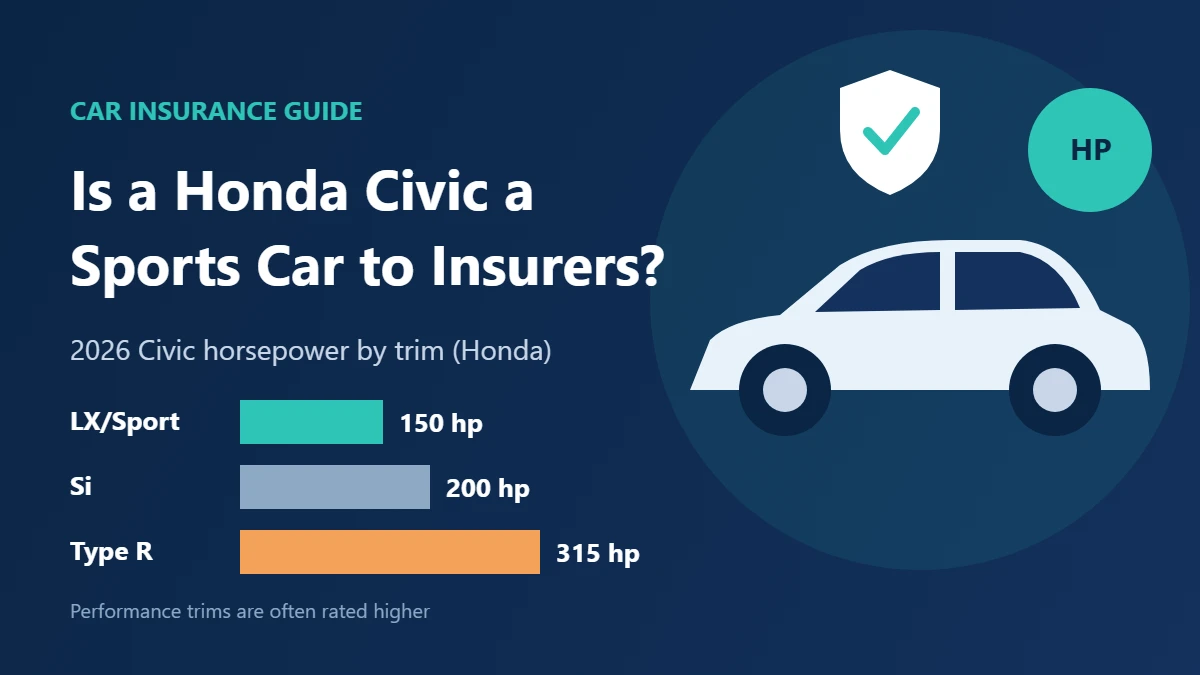
A standard Honda Civic is generally not considered a sports car for insurance. Most insurers treat the regular Civic sedan and hatchback as compact cars. The performance trims are different: the Civic Si and especially the Civic Type R have much more power and are more likely to be rated like sports cars, which can mean higher premiums. Insurers don’t use one universal definition, so how your Civic is rated depends on the exact trim and the company.
Here’s how each Civic trim compares and what drives the price of insuring one.
How Each Civic Trim Compares
| 2026 Civic trim | Horsepower | Likely insurance view |
|---|---|---|
| LX and Sport | 150 hp | Compact car |
| Sport Hybrid and Sport Touring Hybrid | 200 hp total system | Compact car (hybrid) |
| Si | 200 hp (turbocharged) | Often treated as a performance or sport compact |
| Type R | 315 hp (turbocharged) | Commonly rated like a sports car |
Horsepower figures come from Honda’s official 2026 specifications for the Civic Sedan, Civic Si, and Civic Type R. The “likely insurance view” column is a general guide, not an official classification.
What Makes a Car a “Sports Car” to Insurers?
There’s no single legal definition. Insurers rate vehicles based on their own claims data and risk models. The Insurance Information Institute notes that the cost of your car is a major factor in what it costs to insure, along with the likelihood of theft, the cost of repairs, its engine size, and its overall safety record.
Insurers often look at:
- Power and performance, such as horsepower and turbocharging
- Claims history for that model and trim, including how often and how expensive claims are
- Repair and parts costs, especially for performance-specific parts
- Theft rates for the vehicle
- Who tends to buy it, since some models attract riskier drivers
That last point matters. The Insurance Institute for Highway Safety (IIHS) notes in its auto insurance research that losses are influenced by the type of drivers a vehicle appeals to, and that collision claim severity is high among sports cars because of their high prices.
The Standard Civic: A Compact Car
With 150 horsepower in LX and Sport trims, the regular Civic is a mainstream commuter car. The “Sport” name on that trim refers to styling and features, not a high-performance engine, so it’s typically rated like other compact cars. The Civic also earns strong safety marks. IIHS rates the 2026 Civic 4-door sedan a Top Safety Pick, and good crash protection can help keep injury claim costs down.
What About the Civic Hybrid and Hatchback?
The Civic hybrid trims combine a gasoline engine with electric motors for 200 total system horsepower, according to Honda. Even so, they’re designed as efficient commuters, not track cars, so insurers generally treat them as compact cars. Hybrids can sometimes cost a bit more to repair because of their battery and electrical components. The hatchback body style is also usually rated like the sedan, unless it’s a performance trim.
The Civic Si: A Gray Area
The Si has a 200-horsepower turbocharged engine and is offered with a six-speed manual transmission. It’s marketed as a sporty compact, and some insurers may rate it higher than a regular Civic. Others may treat it closer to a standard compact. That’s why it’s important to quote the exact trim rather than “Honda Civic.”
The Civic Type R: Treated Like a Sports Car
With 315 horsepower, the Type R is a true performance car. It’s more expensive to buy and repair, and its performance parts can raise claim costs. Expect many insurers to price it like a sports car, often with noticeably higher collision and comprehensive premiums than a regular Civic.
Why Civic Insurance Can Still Cost More Than Expected
Even a standard Civic can be pricier to insure than you’d expect. Popular cars can have higher theft rates, and repair costs for modern safety technology, like cameras and sensors, add up. Your own profile matters even more: your age, driving record, location, and coverage choices often have a bigger effect on your premium than the car itself.
Does Your VIN Matter?
Yes. Your vehicle identification number tells the insurer the exact model year, body style, and trim. That’s how it knows whether you’re insuring a 150-horsepower LX or a 315-horsepower Type R, so make sure your VIN is entered correctly when you get a quote. If you’ve added aftermarket performance parts, tell your insurer, since modifications can change how your car is rated.
Choosing a Trim? Factor In Insurance
If you’re deciding between a Civic Sport and an Si or Type R, look at the total cost of ownership, not just the sticker price. Ask an insurer to quote each trim with the same coverage and deductibles. For a young or newly licensed driver, the gap between a standard Civic and a Type R can be significant, so a regular trim may be the more practical choice.
How to Lower Insurance on a Civic
- Compare quotes from several insurers, since each rates trims differently.
- Quote before you buy to see the cost difference between trims.
- Raise your deductible if you can afford a higher out-of-pocket cost.
- Ask about discounts for safety features, anti-theft devices, bundling, and good driving.
- Keep a clean record, which matters more than your trim over time.
- Consider usage-based insurance if you drive carefully or rarely.
Learn more about how premiums change over time in our guide to whether car insurance is fixed or variable.
The Bottom Line
A regular Honda Civic is generally not considered a sports car for insurance and is usually rated as a compact car. The Civic Si sits in a gray area, while the 315-horsepower Civic Type R is often priced like a sports car. Because every insurer rates vehicles differently, get quotes for the exact trim before you buy.