
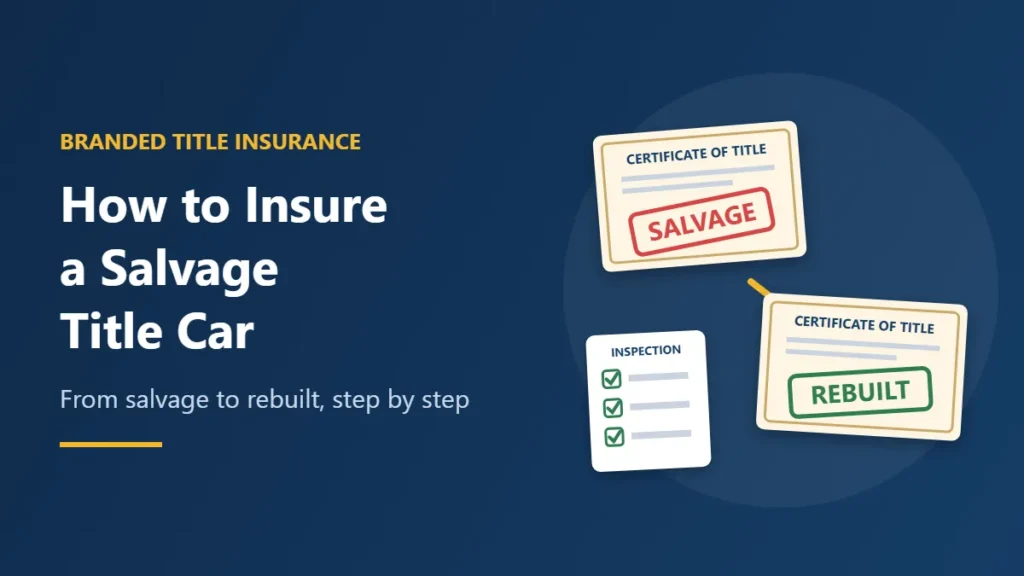
A salvage-title car can be a bargain, but it comes with an insurance puzzle. The short version: you insure a rebuilt car, not a salvage one. Here’s how the process works, step by step.
Short answer: you generally can’t insure a car with an active salvage title for road use, because it can’t legally be driven until it’s repaired, inspected and retitled as rebuilt. Once it has a rebuilt title, most drivers can get liability coverage. Collision and comprehensive are harder to find and may require an inspection and photos. Expect a lower payout value, because a salvage history permanently cuts the car’s worth.
Salvage vs. Rebuilt: The Key Difference
| Title | What it means | Can you drive it? | Insurance |
|---|---|---|---|
| Salvage | Damaged so badly that repair cost more than it was worth, usually as determined by the insurer | No, not on public roads | Generally not for road use |
| Rebuilt (names vary) | Repaired and passed the state’s inspection | Yes, once registered | Liability usually available; full coverage limited |
| Nonrepairable / junk | For parts or scrap only | No, never | No |
In Texas, a salvage vehicle must first be rebuilt and inspected before it can be driven on a road again. Once it passes, its title carries a “Rebuilt Salvage” brand. Virginia likewise bars an active salvage vehicle from its highways and from registration.
Step 1: Repair the Car and Keep Every Record
Insurers and DMVs both want proof the work was done properly. Keep:
- Itemized repair invoices and parts receipts, including VINs for major used parts
- Photos from before repairs, during repairs, and after they’re finished
- The original damage estimate or total-loss paperwork, if you have it
Step 2: Pass the State Inspection and Retitle
Each state runs its own process. Virginia’s rebuilt vehicle exam requires proof of a state safety inspection, receipts for parts, and a photo of the car before repairs, plus a $125 exam fee. Texas requires safety and anti-theft inspections. After you pass, you get a rebuilt-branded title and can register the car.
Step 3: Shop for Insurance
Online quote tools often can’t handle branded titles, so call insurers or use an independent agent who works with several companies. Be upfront about the title. Hiding it can lead to a denied claim or a canceled policy.
Insurers may ask for:
- The rebuilt title and your registration
- Repair receipts and before-and-after photos
- A mechanic’s statement that the car is roadworthy
- Their own inspection or photo inspection before adding collision or comprehensive
What Coverage You Can Get
- Liability: the legal minimum, and usually the easiest to buy, since it pays for damage you cause to others.
- Collision and comprehensive: available from some insurers, often only after an inspection. Others will sell only liability on a rebuilt car.
- Financed rebuilt car: if a lender requires full coverage, confirm an insurer will write it before you buy.
Does It Cost More to Insure?
Often, a bit. Some insurers charge more for rebuilt cars because hidden damage is harder to judge, and there’s no single industry percentage. Liability premiums usually depend mostly on you, the driver, so they may change little. Collision and comprehensive are where a rebuilt title tends to cost more or get restricted. Compare at least three quotes with identical limits and deductibles.
The Value Problem
A salvage history permanently lowers what the car is worth. Kelley Blue Book’s rule of thumb is to deduct 20% to 40% from the normal value, and it notes that a clouded title has a permanent negative effect. Texas’s DMV also warns that rebuilt vehicles will always be worth substantially less.
This affects you in two ways:
- Claim payouts. If the car is totaled again, the insurer pays its actual cash value as a rebuilt car, not what you spent fixing it.
- Is full coverage worth it? On a low-value rebuilt car, collision premiums plus the deductible may exceed what a claim would ever pay.
Example: A clean version of the car is worth $15,000. As a rebuilt car, at 20% to 40% less, it might be worth $9,000 to $12,000. You spent $11,000 buying and fixing it. If it’s totaled, the payout is based on the lower value, minus your deductible.
Before You Buy a Salvage or Rebuilt Car
- Run a title history check. The federal NMVTIS system shows title brands like salvage, junk and flood, and says a brand becomes a permanent part of the record. It also warns that a search can miss things.
- Get insurance quotes first, so you know you can insure it.
- Have an independent mechanic inspect it, especially the frame, airbags and electronics after flood damage.
- Check your state’s rebuild rules and fees before buying an unrepaired salvage car.
Keeping Your Own Totaled Car
If your insurer totals your car and you want to keep it, the payout is usually reduced by its salvage value, and the title gets a salvage brand. You’ll then have to go through the same rebuild, inspection and insurance steps. See should I release my car to the insurance company.
Common Mistakes
- Driving a salvage-title car before it’s retitled
- Throwing away repair receipts or skipping “before” photos
- Assuming full coverage will be available on a financed rebuilt car
- Paying for collision on a car worth only a few thousand dollars
The Bottom Line
To insure a salvage title car, first turn it into a rebuilt car: repair it, document everything, pass your state’s inspection, and retitle it. Then call insurers. Liability is usually available, full coverage sometimes. Budget for the permanent drop in value, and quote insurance before you buy.
This article is general information, not insurance or legal advice. Title names, inspection rules and fees vary by state, and insurer eligibility varies by company. Check with your state DMV and insurer.