
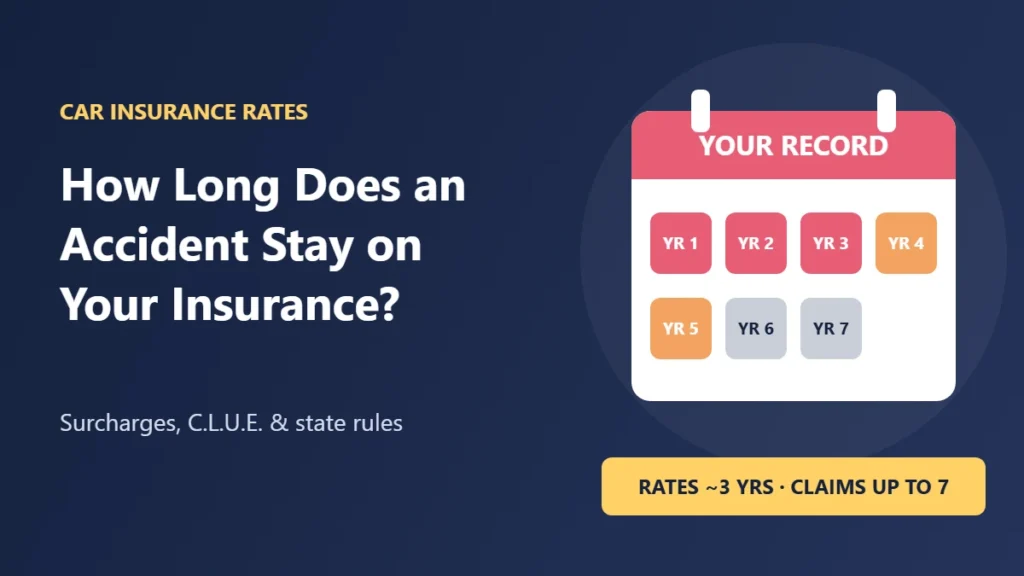
An at-fault accident usually raises your car insurance rates for about three years, and some insurers look back as far as five. The record of the claim lasts longer. Insurance claims databases can keep up to seven years of auto claims history, so insurers may still see an old accident even after it stops affecting your price. Exactly how long you pay more depends on your state, your insurer, whether you were at fault, and how serious the crash was.
Below, you’ll see the three different records that track an accident, how the rules work in a few states, and how to get your rates back down.
Three Records, Three Timelines
When people ask how long an accident “stays on” their insurance, they’re usually mixing up three separate records:
| Record | Who keeps it | How long |
|---|---|---|
| Your insurance rating | Your insurer | Often about 3 years for an at-fault accident, sometimes up to 5 |
| Claims history report (C.L.U.E.) | LexisNexis | Up to 7 years of auto claims |
| Driving record (MVR) | Your state DMV | Varies by state and type of entry |
The insurance rating is what affects your premium. The claims report and driving record are sources insurers check when they quote or renew your policy.
How Long an Accident Affects Your Rates
At-Fault Accidents
Most insurers look at your recent history, commonly the past three years, when setting your price. An at-fault accident inside that window usually brings a surcharge. Once it falls outside, the surcharge typically drops off at your next renewal. Some insurers use a longer lookback, and serious crashes involving injuries or a DUI conviction can keep rates high longer.
Not-at-Fault Accidents
A crash you didn’t cause usually has little or no effect, and some states limit surcharges by law. The California Department of Insurance says that if an accident isn’t your fault, your insurer doesn’t charge you more. If you’re at least 51% at fault, your premium can go up at renewal. Elsewhere, the NAIC notes an insurer may have the right to raise your premium after a second not-at-fault accident in a policy period.
Comprehensive Claims
Claims for theft, hail, flooding, or hitting an animal generally aren’t treated as at-fault accidents. They usually have less impact, though several claims in a short time can still raise your rates. See whether a hail claim raises car insurance rates in Texas.
Examples of State Rules
A few states set the rules directly.
North Carolina uses the Safe Driver Incentive Plan (SDIP). Insurers look at a three-year experience period before your policy starts or renews. At-fault accidents add points, and each point level carries a set surcharge:
| At-fault accident | SDIP points | Rate increase |
|---|---|---|
| Property damage of $2,300 or less | 1 | 40% |
| Property damage over $2,300 but under $3,850 | 2 | 55% |
| Property damage of $3,850 or more, or bodily injury over $1,800, or a death | 3 | 70% |
A property-only accident of $2,300 or less may not add any points if no one in the household has other convictions or at-fault accidents during the experience period.
California requires insurers to offer a Good Driver discount. To qualify, you must have been licensed for at least three years and have no more than one point on your driving record. An at-fault accident can cost you this discount.
Texas lets insurers charge more for accidents and tickets. According to the Texas Department of Insurance, insurers generally can’t refuse to renew your policy because of accidents that can’t reasonably be blamed on you, unless you have more than one such claim in 12 months.
Does Switching Insurers Erase an Accident?
No. New insurers check your claims history and driving record when you apply, so the accident follows you. Shopping around still makes sense, though. Insurers weigh accidents differently, and one may surcharge less than another for the same claim.
Check Your Claims Report for Free
According to the Consumer Financial Protection Bureau, LexisNexis’s C.L.U.E. database reports up to seven years of auto insurance claims and provides one free report every 12 months on request. Review it before shopping for insurance. If a claim is listed wrong, for example as at-fault when it wasn’t, you can dispute it.
How to Lower Your Rates After an Accident
- Keep a clean record. Every year without another accident or ticket brings you closer to the surcharge dropping off.
- Ask about accident forgiveness. Some insurers waive the surcharge for a first accident, often if you’ve been accident-free for several years. Check the details before you need it.
- Take a defensive driving course. Some insurers and states offer discounts for an approved course.
- Raise your deductible if you have enough savings to cover it.
- Compare quotes at renewal, especially when your accident is about to reach the end of its lookback period.
- Think twice about small claims. Paying for a minor repair yourself can sometimes cost less than several years of surcharges. You still need to report the accident to your insurer. See how long to report a car accident to insurance.
Frequently Asked Questions
Will my rates drop automatically after three years?
Usually, at your first renewal after the accident leaves your insurer’s lookback period. If they don’t, ask your insurer or get new quotes.
Does an accident without a claim affect my insurance?
It can if a police report or ticket shows up on your driving record, or if the other driver files a claim against your policy.
How much will my rates go up after an at-fault accident?
It depends on your insurer, state, and the size of the claim. In North Carolina, the SDIP sets the increase at 40% to 70% for a single at-fault accident. In most other states, each insurer sets its own surcharge, so quotes can differ widely.
The Bottom Line
An at-fault accident typically affects your car insurance rates for about three years, sometimes up to five, while claims databases can keep the record for up to seven. Not-at-fault accidents usually matter less. Check your C.L.U.E. report, avoid new incidents, and compare quotes as the accident ages off your record.