
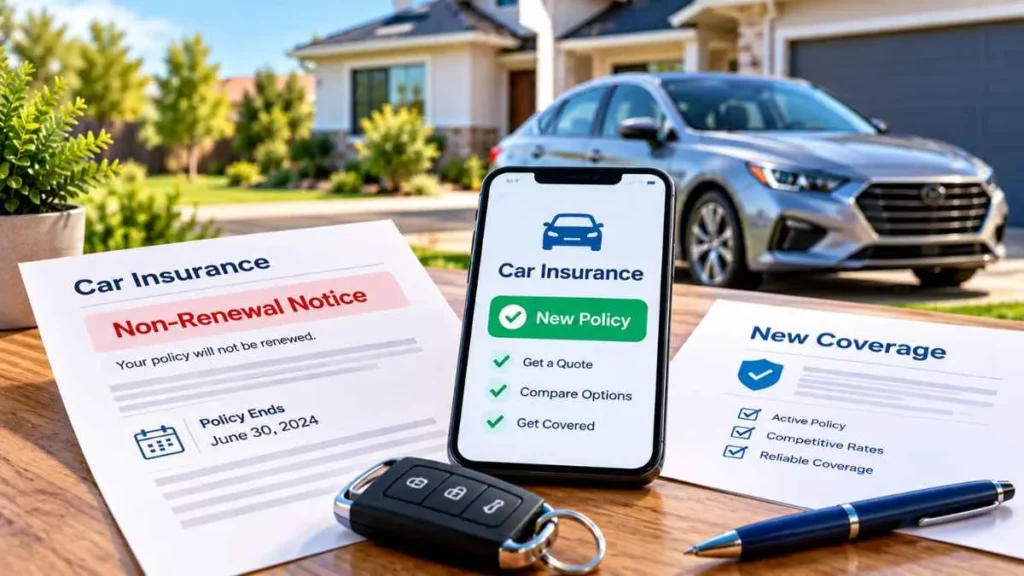
Getting a non-renewal notice from your car insurance company can be stressful, but it does not mean you cannot get coverage again. If you are wondering how to get car insurance after non renewal, the most important step is to act before your current policy expires. Understanding why your insurer will not renew you, checking your records, comparing insurers, and avoiding a coverage gap can help you find replacement coverage.
What Does Car Insurance Non-Renewal Mean?
Car insurance non-renewal means your insurer has decided not to continue your policy for another term. Unlike cancellation, non-renewal generally takes effect when the current policy period ends.
For example, if your policy expires on June 30 and your insurer sends a non-renewal notice, your existing coverage generally continues through the current policy term. You will need a new policy after that date if you want to maintain required insurance coverage.
Non-renewal does not automatically mean you are a high-risk driver or that other insurers will reject you. State rules and the reason for the non-renewal matter.
Why Do Insurance Companies Non-Renew Car Insurance?
Insurance companies can non-renew policies for different reasons. Common driver-related factors include:
- Multiple accidents
- Frequent or expensive claims
- Serious traffic violations
- DUI convictions
- License problems
- Incorrect or incomplete information
- Failure to provide requested documents
However, the decision may have nothing to do with your driving. An insurer may reduce business in a particular area, change its underwriting guidelines, or stop writing certain policies.
That is why you should carefully read your non-renewal notice and identify the exact reason.
What to Do After Receiving a Non-Renewal Notice
1. Read the Notice Carefully
Check the reason for non-renewal, policy expiration date, effective date, and any instructions provided by the insurer. Notice requirements vary by state.
2. Confirm When Your Coverage Ends
Check your non-renewal letter, declarations page, insurance ID card, or online account. Do not rely on memory. Knowing the exact expiration date gives you time to arrange replacement coverage.
3. Contact Your Insurance Company
If the reason is unclear, ask:
- Why is my policy being non-renewed?
- Is the information accurate?
- Can the decision be reconsidered?
- Is there anything I can do before the policy expires?
If you believe the insurer used incorrect information, request an explanation and dispute errors when appropriate.
4. Check Your Driving and Claims History
Review your motor vehicle record, accident history, and claims information. Correcting inaccurate records before applying for new insurance can help prevent problems during underwriting.
5. Start Comparing Quotes
Do not wait until the last day. Get quotes from multiple insurers and request similar coverage limits and deductibles so you can compare policies fairly.
How to Find Car Insurance After Non-Renewal
Start With Standard Insurers
A non-renewal from one company does not automatically mean another insurer will reject you. Start by getting quotes from standard insurance companies.
Consider an Independent Insurance Agent
An independent agent may work with multiple insurance carriers and can help you find insurers that fit your situation. This can be especially useful if you have multiple claims, accidents, violations, or difficulty getting standard quotes.
Consider Non-Standard Insurance
If standard insurers decline your application, non-standard or high-risk insurance may be another option. These policies can cost more depending on your driving history, claims, location, and the insurer’s underwriting rules.
Check Assigned-Risk Options
If you cannot obtain coverage through the voluntary market, ask your insurance agent or state insurance department whether your state has an assigned-risk or residual-market program.
How to Avoid a Coverage Gap
Your replacement policy should begin when your existing policy ends.
For example:
Old policy ends: June 30
New policy starts: July 1
Do not assume you are insured simply because you received a quote. Confirm that the new policy has been bound, make the required payment, and obtain proof of insurance.
Driving without legally required insurance can result in financial and legal consequences, depending on your state.
Will Non-Renewal Make Your Insurance More Expensive?
Not necessarily. A non-renewal itself does not determine your new premium.
Your next insurer may consider factors such as:
- Accident history
- Claims history
- Traffic violations
- DUI convictions
- Insurance lapses
- Location
- Vehicle
- Coverage limits and deductibles
For example, if your insurer stopped writing policies in your area, the non-renewal may have little connection to your individual driving risk. If you were non-renewed after several recent accidents, those underlying accidents may affect your next premium.
Can You Get Insurance After an Accident or Multiple Claims?
Yes, potentially. An accident-related non-renewal does not automatically make you uninsurable.
Multiple claims can make finding affordable coverage more difficult, but insurers use different underwriting criteria. Shop with several companies and consider an independent agent or non-standard insurer if necessary.
Always provide accurate information about your accidents, claims, and previous insurance.
Does Non-Renewal Go on Your Driving Record?
Generally, a non-renewal itself is not a traffic violation. Your driving record is more likely to contain events such as accidents, speeding tickets, DUI convictions, or license violations.
However, the underlying event that contributed to the non-renewal may affect your driving or insurance history.
Does Non-Renewal Require an SR-22?
No. A non-renewal by itself does not automatically create an SR-22 requirement.
An SR-22 is generally associated with a separate state-required financial-responsibility situation, such as certain serious driving violations. If you already have an SR-22 requirement, tell your new insurer so the required filing can continue.
Rules vary by state.
What If No Insurer Will Cover You?
If several insurers decline your application:
- Try additional standard insurers.
- Contact an independent insurance agent.
- Consider non-standard coverage.
- Ask about your state’s assigned-risk or residual-market program.
- Contact your state insurance department for applicable options.
Final Takeaway
A car insurance non-renewal does not mean you are permanently uninsurable. First, understand why your policy is not being renewed, verify your driving and claims information, and start comparing replacement coverage early.
If standard insurers do not work, an independent agent, non-standard insurer, or state-specific residual-market option may provide additional choices. Most importantly, arrange new coverage before your current policy expires so you can avoid an unnecessary insurance gap.