
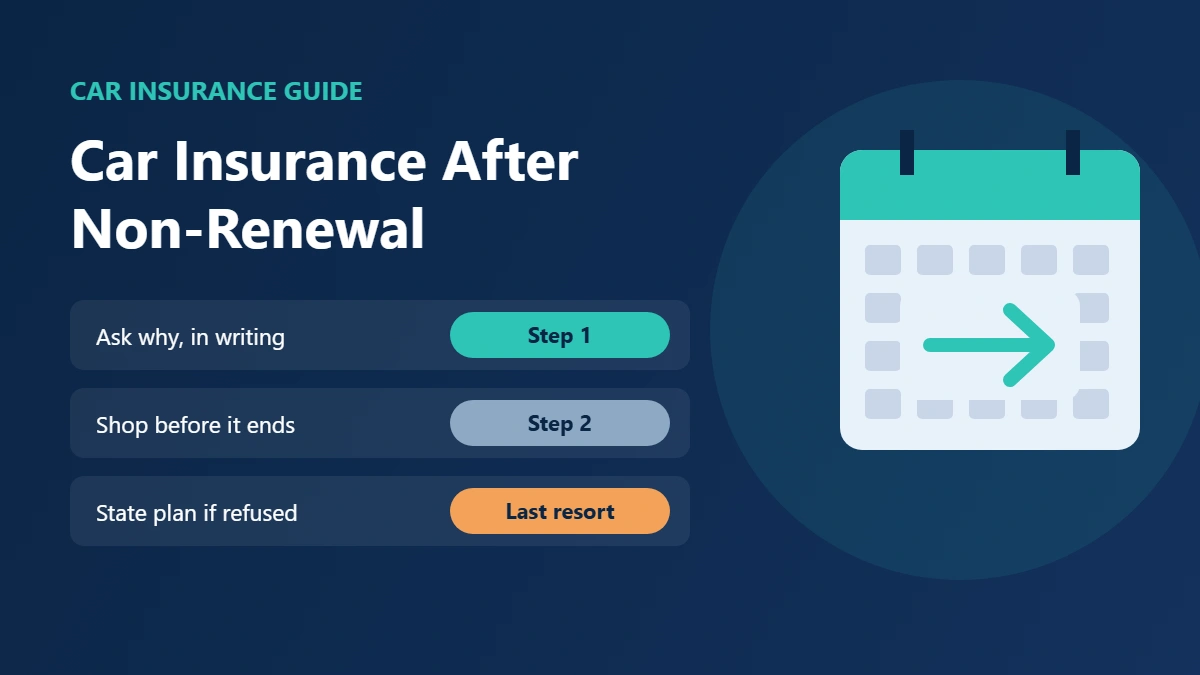
If your insurer won’t renew your car insurance, you can still get covered, and you usually have time to do it. A non-renewal means your current policy ends at the end of its term, not immediately. Use that window to find out why, compare quotes from standard and high-risk insurers, and have a new policy start before the old one ends. If every company turns you down, most states offer a last-resort plan so you can still drive legally.
Here’s a step-by-step plan to replace your coverage without a gap.
Non-Renewal vs. Cancellation
| Non-renewal | Cancellation | |
|---|---|---|
| When coverage ends | At the end of the policy term | Before the term ends |
| Common reasons | Claims, tickets, accidents, insurer leaving an area | Nonpayment, fraud, license suspension |
| Your next step | Shop for a new policy before the end date | Act immediately to avoid a lapse |
Notice rules vary by state. In Texas, for example, the Department of Insurance says a company must give you at least 60 days’ notice of a nonrenewal.
Why Insurers Don’t Renew Policies
A non-renewal isn’t always about you. The Texas Department of Insurance lists common reasons, including:
- A DUI or DWI conviction
- Multiple accidents or traffic tickets
- Many claims, especially for crashes you caused
- Not responding to the company or not cooperating with a claim investigation
- The company stopped selling policies in your area
If your insurer is leaving your area or reducing business, your driving record may be fine, and you can likely find similar coverage elsewhere at a comparable price.
Step 1: Read the Notice and Confirm the End Date
Find the exact date and time your coverage ends. That’s your deadline for having new coverage in place. Add it to your calendar with a reminder two weeks earlier.
Step 2: Ask Why
Knowing the reason tells you how hard your search will be. In Texas, your company must give you the reason for the nonrenewal if you ask, and for policies nonrenewed after January 1, 2026, it must give you a written statement explaining why. If the reason is based on an error, such as a claim that wasn’t yours, ask the insurer to correct it and reconsider.
Step 3: Ask About Keeping Your Policy
TDI also suggests asking your agent or company whether they can reinstate your policy. It’s worth asking, especially if the issue was a missed communication or a fixable mistake.
Step 4: Shop With Standard Insurers First
Get quotes from several major insurers, even if you’ve had claims. Each company weighs risk differently, and one insurer’s reject can be another’s acceptable customer. Answer every application question honestly, including whether you’ve been non-renewed. Misstating your history can lead to a canceled policy or a denied claim later.
Step 5: Use an Independent Agent and Non-Standard Insurers
An independent agent can quote multiple companies at once, including non-standard insurers that specialize in higher-risk drivers. Their premiums are usually higher, but they’re a practical bridge while you rebuild your record.
Step 6: Use Your State’s Last-Resort Plan if Needed
If no company will sell you a policy, most states have a residual market plan, sometimes called an assigned-risk plan, that guarantees basic coverage. In Texas, you can get minimum coverage through the Texas Automobile Insurance Plan Association if two insurance companies have turned you down. Some states also have special programs. California’s Low Cost Auto Insurance Program, for example, provides income-eligible drivers with liability coverage at affordable rates. Ask an agent or your state insurance department how to apply.
Step 7: Start the New Policy Before the Old One Ends
Set your new policy’s start date on or before your current policy’s end date. Then confirm the new policy is active before your old coverage expires.
Don’t Let Your Coverage Lapse
A gap can make your next policy more expensive and create legal trouble. In New York, the Department of Motor Vehicles can suspend your registration and driver license if there’s a lapse in insurance on a vehicle registered to you, and a license is suspended when the lapse reaches 91 days or more. If a gap has already happened, see how to get car insurance after a lapse. And remember that you can’t fix a gap by backdating a new policy. Here’s why you can’t backdate car insurance.
Will Your New Insurance Cost More?
It depends on the reason. If your insurer simply left your area, your new rate may be similar. If the non-renewal followed accidents, tickets, or several claims, expect to pay more, since those factors drive pricing at every company. Rates often improve as violations and claims age off your record, so keep driving safely and shop again at each renewal.
How to Avoid Another Non-Renewal
Once you’ve found new coverage, a few habits can help you keep it:
- Pay on time. Set up automatic payments so a missed bill doesn’t turn into a cancellation.
- Think before filing small claims. For minor damage close to your deductible, paying out of pocket can keep your claims history cleaner.
- Respond to your insurer. Answer requests for information and cooperate fully with any claim investigation.
- Keep your driving record clean. Tickets and at-fault accidents are among the most common reasons for non-renewal.
- Keep coverage continuous. A history of uninterrupted insurance makes you a more attractive customer to every insurer.
The Bottom Line
A non-renewal gives you time to find new car insurance before your current policy ends. Ask why you were non-renewed, request a fix if there’s an error, and compare quotes from standard insurers, independent agents, and non-standard companies. If everyone says no, your state’s last-resort plan can provide basic coverage. Above all, have your new policy start before the old one ends.