
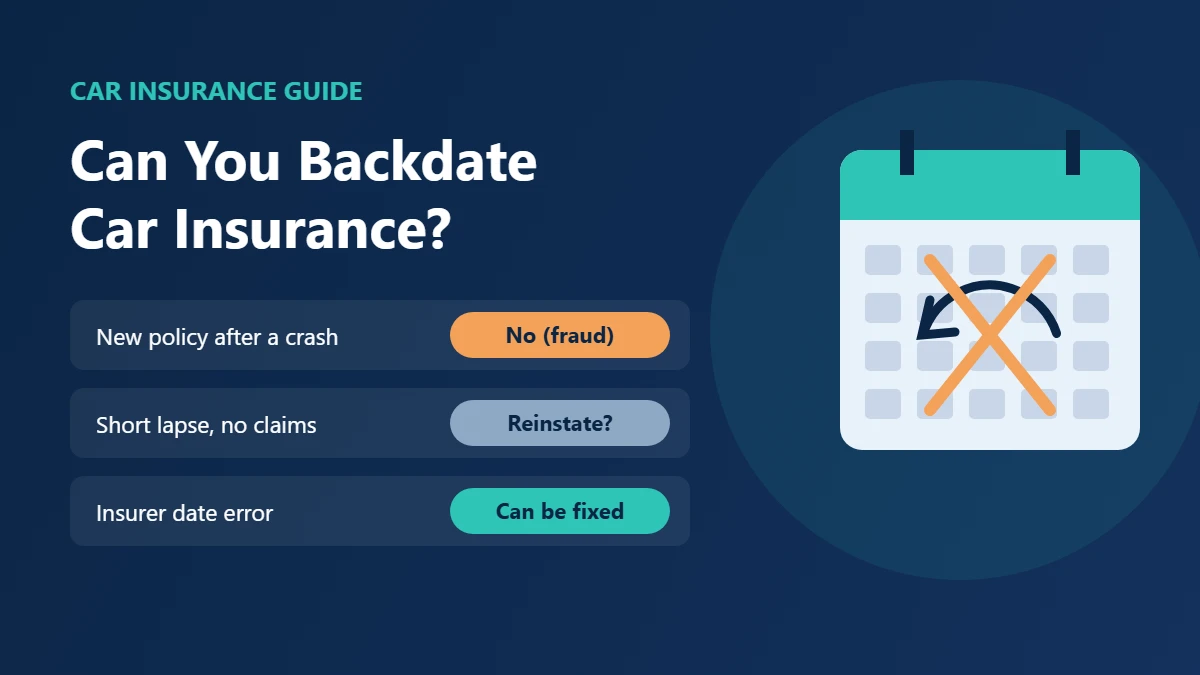
No, you can’t backdate a new car insurance policy. Coverage starts when you buy it, and buying a policy after an accident while claiming it was already in force is insurance fraud. There are two legitimate exceptions that people sometimes confuse with backdating: your insurer may be willing to reinstate a policy that lapsed briefly, and a genuine mistake in your policy’s start date can be corrected with proof.
Here’s what’s possible, what isn’t, and what to do if your coverage has already lapsed.
What Does Backdating Car Insurance Mean?
Backdating means setting a policy’s start date earlier than the day you actually bought it. For example, your old policy ended on September 20, you buy a new one on September 24, and you ask for it to start on September 20 so there’s no gap. That might sound harmless, but insurers won’t cover a period that has already passed, because they can’t know whether something happened during it.
Can You Backdate in These Situations?
| Situation | Possible? |
|---|---|
| You had an accident while uninsured, then bought a policy | No. Claiming earlier coverage is fraud |
| Your policy was canceled for nonpayment a few days ago, and nothing happened | Maybe, if your insurer agrees to reinstate it |
| Your agent or insurer entered the wrong start date | Usually yes, with proof of the original request |
| You need proof of insurance for a past gap for the DMV | No. You’ll have to resolve the lapse with the state |
| You want a lower price by starting a policy earlier | No. Coverage begins when the policy is issued |
Why Backdating After an Accident Is Fraud
Insurance pays for uncertain future events. If people could buy coverage after a crash and date it earlier, everyone else’s premiums would rise to pay for those losses. That’s why regulators treat it seriously.
The Insurance Information Institute defines insurance fraud as a deliberate deception against or by an insurance company or agent for financial gain, including misrepresenting facts on an insurance application. It cites estimates that fraud can cost U.S. consumers $308.6 billion a year.
Backdating cases do get prosecuted. In 2023, Insurance Journal reported that a North Carolina insurance agent and a driver were charged with fraud after the agent allegedly added the driver’s uninsured vehicle to her own policy minutes after an accident and showed it to police as proof of coverage. If an agent ever offers to backdate a policy for you, say no.
Reinstatement: The Legitimate Exception
If your existing policy was canceled, often for a missed payment, your insurer may let you reinstate it. The Texas Department of Insurance advises drivers whose policy was canceled to ask their agent or company if they can reinstate it.
Reinstatement is up to the insurer and depends on its rules, your state, the reason for cancellation, and how much time has passed. Some insurers will reinstate with no gap, and others will restart coverage only from the reinstatement date. Many ask you to confirm in writing that no accidents or losses happened while the policy was inactive. Only sign that if it’s completely true. A false statement can lead to a denied claim, a canceled policy, or fraud charges.
Know Your Cancellation Notice
Lapses often happen because a payment is missed and the cancellation notice gets overlooked. In Texas, for example, an insurer must give you 10 days’ notice before canceling your policy, and it must refund unearned premium within 15 days after cancellation. Notice rules vary by state, so read every letter or email from your insurer and act before the cancellation date.
What a Lapse Can Cost You
Even a short gap can have consequences. In New York, the Department of Motor Vehicles says that if there is a lapse of insurance for a vehicle registered to you, it can suspend your registration and driver license. A license is suspended when the lapse is 91 days or more. The DMV also notes that a lapse ends when, among other things, your insurer reinstates your coverage.
A lapse can also raise your future premiums, since many insurers charge more to drivers without continuous coverage. If you financed or leased your car, your lender may buy insurance on your behalf and bill you for it. For next steps, see how to get car insurance after a lapse.
What If You Had an Accident During a Lapse?
A new policy won’t cover it. Be honest with any insurer you contact. If the other driver was at fault, their liability insurance should still pay for your damage and injuries. If you were at fault, you may be personally responsible for the other driver’s losses, and your state may impose penalties for driving uninsured. In that situation, talking to an attorney can help.
What to Do If Your Insurance Lapsed
- Call your insurer right away and confirm the exact cancellation date and time.
- Ask about reinstatement and whether it would leave a gap.
- Pay any past-due premium the insurer requires.
- Answer loss questions truthfully if asked about the lapse period.
- Get new coverage immediately if reinstatement isn’t available, and don’t drive until you’re insured.
- Get the effective date in writing for your records.
- Check with your DMV if your state tracks lapses or requires you to respond to a notice.
The Bottom Line
You can’t backdate car insurance. A new policy starts when you buy it, and claiming earlier coverage after an accident is fraud that has led to criminal charges. If your policy lapsed recently and nothing happened, ask your insurer about reinstatement, and if your start date was entered wrong, ask for a correction with proof. Otherwise, get insured right away and resolve any lapse with your state’s DMV.