
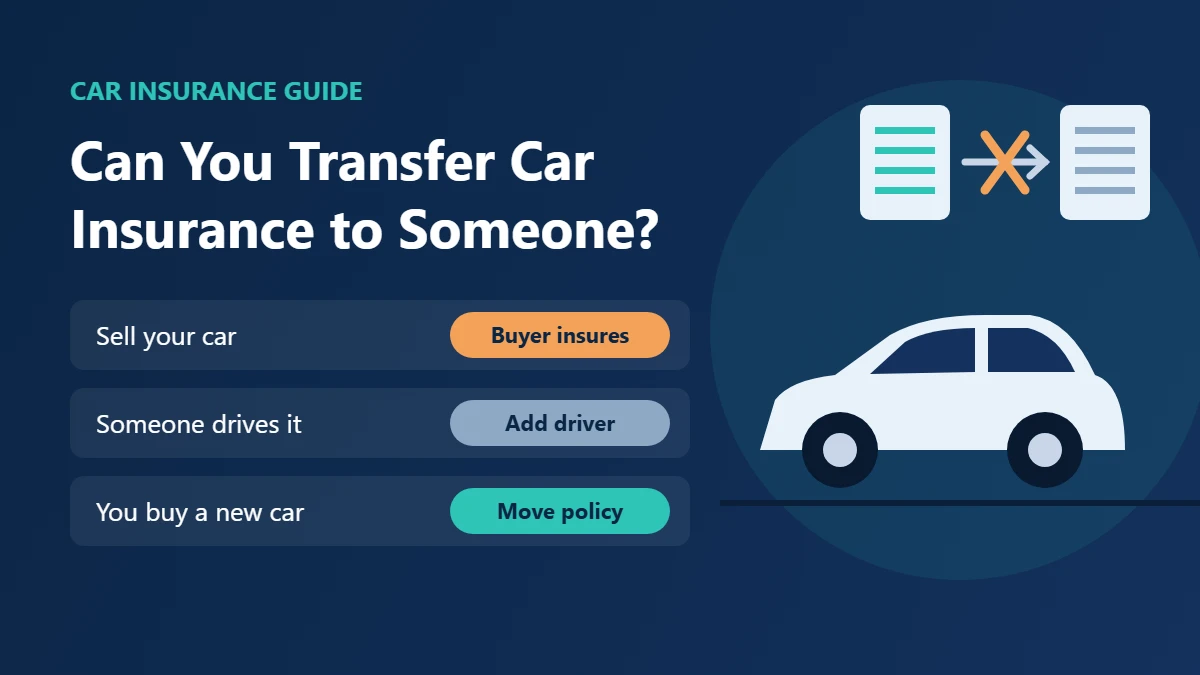
Usually, no. A car insurance policy is a contract between you and your insurer, priced on your driving record, address, and vehicle, so you can’t simply hand it to a buyer, friend, or relative. Instead, the other person gets their own policy, you add them as a driver, or you move your coverage to your next car. The main exception is when a policyholder dies, in which case a surviving spouse or estate may be able to continue the policy.
Here’s what to do in each common situation, including how to handle insurance when you sell a car.
Why Car Insurance Doesn’t Transfer
Your premium reflects you: your age, driving history, claims, credit (in most states), and where the car is kept. Another person carries a different risk, so the insurer needs to evaluate them separately. That’s why most auto policies don’t allow you to assign your coverage to someone else without the insurer’s consent. Any change of the named policyholder is handled by the insurer, not by you and the other person.
What to Do Instead
| Your situation | What usually happens |
|---|---|
| You sell your car | The buyer gets their own policy; you cancel or remove the car after the sale |
| You give your car to a family member | They insure it in their name once the title is transferred |
| Someone in your household drives your car | Add them to your policy as a driver |
| A friend borrows your car occasionally | Your policy may cover them under permissive use |
| You replace your car | Move your existing policy to the new vehicle |
| The policyholder dies | A surviving spouse or executor may continue the policy |
Selling Your Car: Timing Your Insurance
The buyer can’t take over your policy, so the key question is when to cancel yours. According to Progressive, you can cancel your car insurance after selling once you’ve signed over the title, completed the bill of sale, and submitted a release of liability to your state’s motor vehicle agency, if your state requires one. If the car is still registered in your name, you still need a policy.
Don’t cancel too early. Progressive warns that canceling too soon can lead to legal problems, and you could be held responsible for accidents involving the car while it’s still yours.
Some states add their own steps. In New York, for example, the Department of Motor Vehicles says that if your liability insurance is about to end and you won’t replace it, you must surrender your plates before the coverage lapses. Otherwise your registration can be suspended.
The buyer has their own responsibility. Progressive notes that even where insurance isn’t needed for a title change, the buyer must have coverage to register the vehicle.
What Happens to the Months You Already Paid?
You can’t pass unused premium to the buyer, but you usually don’t lose it either. When you cancel, most insurers refund or credit the unused portion of your premium, though some charge a cancellation fee. Ask your insurer how the refund is calculated before you cancel.
Adding Someone Instead of Transferring
If the goal is to let someone else drive your car, adding them as a driver is usually the answer. Insurers generally expect people who live with you or drive your car regularly to be listed on your policy.
For occasional drivers, permissive use may apply. As this guide to the standard personal auto policy explains, a driver with your permission is generally covered under your policy. That covers borrowing, not ownership, so it isn’t a way to transfer coverage.
For families, see how long kids can stay on their parents’ car insurance. Couples can also compare whether combining car insurance with a partner saves money.
Giving a Car to a Family Member
When you gift a car, ownership moves to the other person, and so does the responsibility to insure it. They’ll need a policy in their own name, or they can be added as a car owner on a household policy if they live with you and the insurer allows it. If you’ll keep the title and simply let them drive, see whether you can insure a car you don’t own for how insurable interest works.
When the Policyholder Dies
Death is the one situation where coverage can pass to someone else. According to Progressive, a surviving spouse or estate executor may sometimes inherit an auto policy that continues after the driver dies. The family should notify the insurer, and may need to provide a copy of the death certificate to either end the policy or transfer it.
Keep the car insured until it’s sold, retitled, or the estate is settled, so the estate isn’t exposed to liability if the car is driven or damaged.
Moving Your Policy to a New Car
Your policy can’t go to another person, but it can follow you to your next vehicle. If you replace your car, call your insurer to swap the old vehicle for the new one. Progressive notes that, depending on your insurer, you may have anywhere from a week to a month to add a newly purchased car, and your existing coverages typically apply in the meantime. Don’t rely on that grace period for long, especially if the new car is financed.
The Bottom Line
You can’t transfer your car insurance to another person. When you sell or give away a car, the new owner needs their own policy, and you should keep yours until the title and any release of liability are complete. To let someone drive your car, add them as a driver or rely on permissive use for occasional trips. Coverage can follow you to a new car, and in limited cases, it can pass to a surviving spouse or estate.