
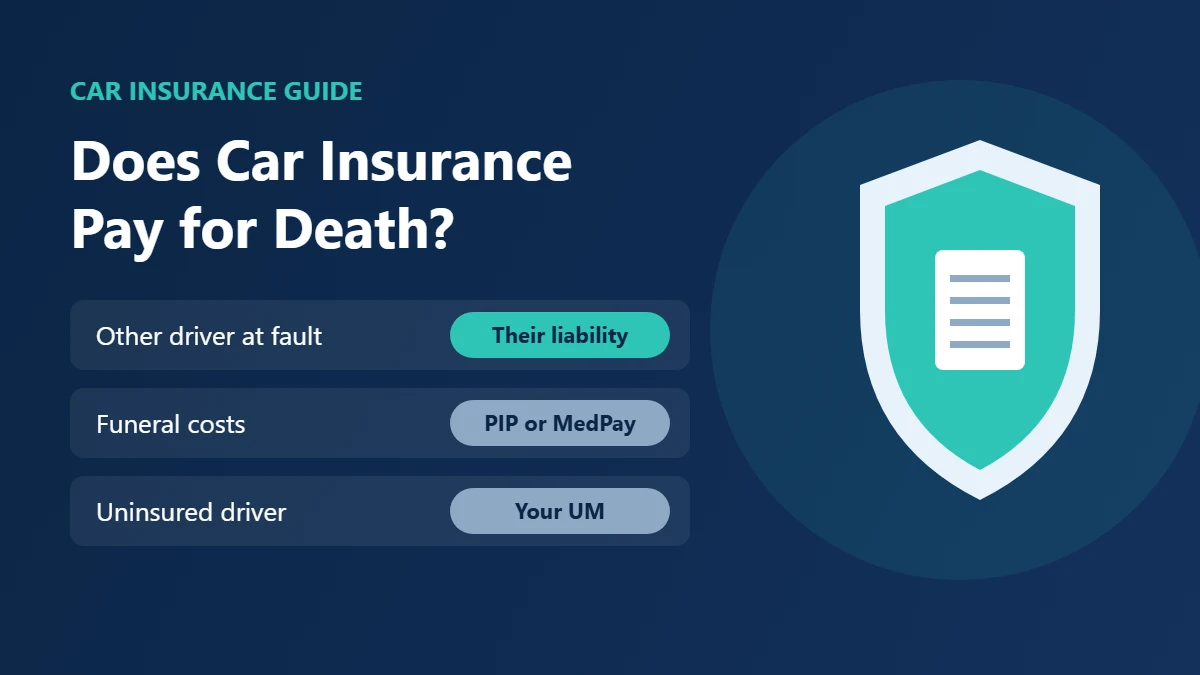
Yes, car insurance can pay when someone dies in a car accident, but usually not as a simple life insurance-style payout. If another driver caused the crash, their bodily injury liability coverage can pay the family’s wrongful death claim, up to the policy limits. Depending on your state and coverage, your own policy may also help through personal injury protection (PIP), medical payments coverage (MedPay), or uninsured motorist coverage. A few no-fault states also include a set death benefit.
If you’ve lost someone, we’re sorry. This guide explains which coverages may pay, what they typically cover, and the first steps for the family.
Which Car Insurance Coverages Can Pay After a Death?
| Coverage | Whose policy | What it can pay for |
|---|---|---|
| Bodily injury liability | The at-fault driver’s | Wrongful death damages owed to the family, up to the limit |
| Personal injury protection (PIP) | The victim’s own, in no-fault states | Medical bills, lost wages, funeral costs; some states add a death benefit |
| Medical payments (MedPay) | The victim’s own | Medical and funeral expenses, regardless of fault |
| Uninsured/underinsured motorist | The victim’s own | Damages when the at-fault driver has no or too little insurance |
When Another Driver Caused the Death
This is the most common way car insurance pays after a fatal crash. According to the Insurance Information Institute, bodily injury liability covers costs associated with injuries and death that a driver causes while driving.
The deceased person’s family, usually through the estate’s personal representative, can file a wrongful death claim against the at-fault driver. That claim may include medical bills before death, funeral and burial costs, lost income the person would have provided, and other losses the state allows. The at-fault driver’s insurer handles the claim and pays up to the policy’s limits.
Limits matter. If the driver carries only their state’s minimum coverage, the policy may pay far less than the family’s actual losses. In that case, the family may need to turn to their own underinsured motorist coverage or pursue the driver personally.
Does Car Insurance Pay Funeral Costs?
Often, yes. As the National Association of Insurance Commissioners explains, PIP, which is available in no-fault states, can cover lost wages and funeral costs up to the policy’s limit.
MedPay can help too, even in states without PIP. For example, State Farm describes its MedPay coverage as helping pay medical and funeral expenses when a covered person is hurt in an auto accident, no matter who is responsible. Most states don’t require MedPay, so check whether the policy includes it.
Funeral costs can also be part of a wrongful death claim against an at-fault driver’s liability coverage.
Does Car Insurance Have a Death Benefit?
Standard auto policies generally don’t include a life insurance-style death benefit. A few no-fault states are the exception. In New York, for example, the Department of Financial Services says no-fault coverage includes up to $50,000 per person in basic benefits, plus a $2,000 death benefit payable to the estate of an eligible person killed in a motor vehicle accident.
Some insurers also sell optional accidental death coverage, but it isn’t standard and amounts are usually modest. For real financial protection for your family, life insurance is the right tool, not car insurance.
What If the At-Fault Driver Was Uninsured?
If the driver who caused the crash had no insurance, or fled the scene, the family can look to the victim’s own uninsured motorist (UM) coverage. The NAIC notes that uninsured motorist coverage reimburses you if an uninsured or hit-and-run driver hits you. If the at-fault driver had some insurance but not enough, underinsured motorist (UIM) coverage may make up part of the difference.
The family may also be able to sue the uninsured driver directly, though collecting can be difficult. See whether you can sue someone for not having car insurance.
What If the Person Who Died Caused the Crash?
If the deceased driver was at fault, their own liability coverage can still pay for injuries and damage they caused to others. Their family usually can’t file a liability claim against their own policy for the death. However, the family may still receive PIP or MedPay benefits from that policy, such as funeral costs or a state death benefit, depending on the state and coverage.
Passengers are treated differently. If a passenger dies, their family may have a claim against the at-fault driver’s liability coverage, even if that driver was a friend or relative. Benefits like PIP or MedPay may come from the vehicle’s policy or the passenger’s own household policy, depending on state rules.
Steps for the Family After a Fatal Accident
- Get the police report and the names and insurance details of every driver involved.
- Notify both insurers: the deceased person’s insurer and the at-fault driver’s insurer.
- Find the deceased person’s policy and check for PIP, MedPay, and uninsured motorist coverage.
- Keep every receipt, including medical, funeral, and burial costs.
- Identify the estate’s representative, who usually files the wrongful death claim.
- Don’t sign a release or accept a settlement until you understand what you’re giving up.
- Talk to a wrongful death attorney. Rules on who can file, what can be recovered, and filing deadlines vary by state, and missing a deadline can end the claim.
If an insurer delays or denies a valid claim, see what to do when car insurance won’t pay.
The Bottom Line
Car insurance can pay after a death, mainly through the at-fault driver’s bodily injury liability coverage, which pays wrongful death claims up to the policy limit. The victim’s own PIP or MedPay may cover funeral costs, uninsured motorist coverage can step in if the other driver had no insurance, and a few states, such as New York, add a small death benefit. Car insurance isn’t a substitute for life insurance, and because wrongful death rules differ by state, families should get legal guidance early.