
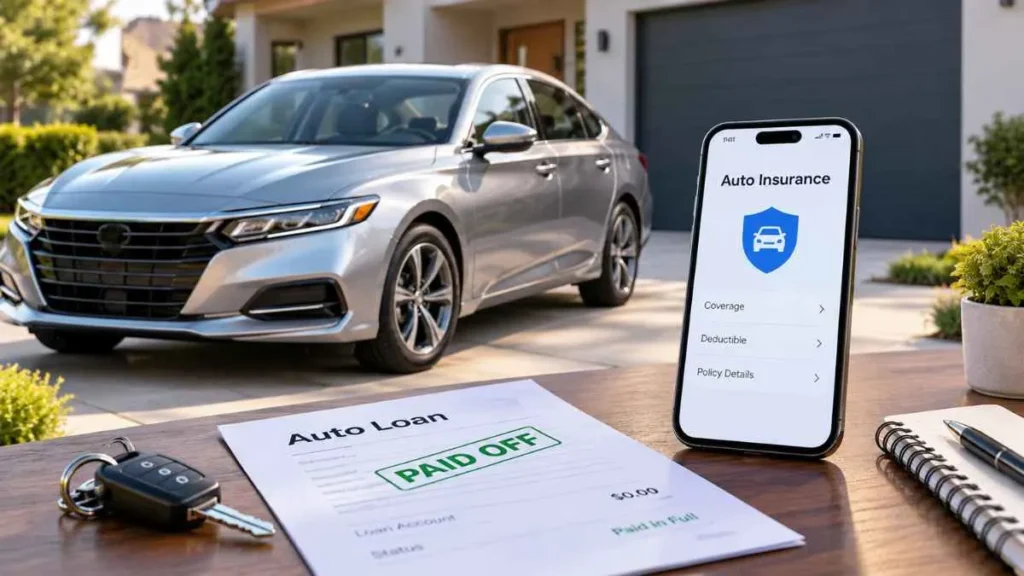
Does paying off your car lower your insurance? Not automatically. Paying off an auto loan does not usually trigger a lower insurance premium because insurers consider factors such as your driving record, location, vehicle, coverage, deductible, and claims history. However, owning your car outright gives you more flexibility to review your policy. You may be able to adjust your deductible, reconsider optional coverage, remove GAP protection, or compare quotes from other insurers.
Does Paying Off a Car Loan Lower Insurance?
No, paying off a car loan does not automatically lower your car insurance premium. The amount you owe on the vehicle is generally not the main factor determining your insurance rate.
Instead, insurers typically consider factors such as:
- Driving record
- Location
- Vehicle type and model
- Claims history
- Coverage limits
- Deductibles
- Mileage and vehicle use
- Insurance company
- State-specific rules and rating factors
For example, if you paid off your car but kept the same vehicle, coverage, limits, and deductible, your monthly premium could remain $180. Paying off the loan itself does not create an automatic insurance discount.
Why Your Insurance May Not Get Cheaper
Paying off your loan does not automatically change the factors insurers use to price your policy. Your risk profile and selected coverage can remain exactly the same after the loan balance reaches $0.
The important difference is that you now own the vehicle outright and may have more freedom to change your policy.
What Changes After You Pay Off Your Car?
The biggest practical change is that the lender no longer has a financial interest in your vehicle.
The Lienholder Can Be Removed
After paying off the loan, contact your insurer and provide any required payoff or lien-release documentation. The insurer can then update the policy and remove the lender from the policy.
Lender Coverage Requirements May End
When a vehicle is financed, lenders commonly require comprehensive and collision coverage to protect their financial interest in the vehicle.
After the loan is paid off, those lender requirements generally no longer apply. However, state insurance requirements still apply.
You Have More Coverage Flexibility
You can review whether your current policy still fits your needs. You may choose to:
- Keep the same coverage
- Increase your deductible
- Reconsider collision coverage
- Reconsider comprehensive coverage
- Compare quotes from other insurers
Can You Lower Insurance After Paying Off Your Car?
Potentially, yes—but the savings usually come from changing your policy, not from paying off the loan.
Increase Your Deductible
A deductible is the amount you pay toward a covered claim before insurance pays the remaining covered amount.
For example, increasing a deductible from $500 to $1,000 may lower your premium. However, you would have to pay more out of pocket after a covered claim, so choose an amount you can afford.
Consider Dropping Collision Coverage
Collision coverage can help pay for damage to your vehicle caused by a collision with another vehicle or object.
After payoff, some owners may reconsider collision coverage if their vehicle has relatively low value and they could afford to repair or replace it themselves. Removing it also means taking on more financial risk.
Consider Dropping Comprehensive Coverage
Comprehensive coverage can protect against non-collision losses such as:
- Theft
- Fire
- Vandalism
- Certain weather-related damage
- Animal-related damage
Removing comprehensive coverage may lower your premium, but you would generally be responsible for covered losses yourself.
Shop Around for New Quotes
Compare quotes from multiple insurers using similar coverage limits, deductibles, and optional coverages. A lower premium is not necessarily a better deal if it also provides less protection.
Do You Still Need GAP Insurance After Paying Off Your Car?
Generally, no. GAP coverage is designed to help cover the difference between what you owe on a vehicle loan and what your insurer pays if the vehicle is stolen or totaled.
For example, if your car is worth $20,000 but you owe $24,000, GAP may help cover the $4,000 difference, depending on the agreement.
Once your loan balance reaches $0, there is generally no remaining loan balance for GAP to cover. Check your loan documents and GAP agreement because you may be eligible for a refund of unused GAP charges, but do not assume a refund is automatic.
Should You Drop Full Coverage After Paying Off Your Car?
There is no universal answer. Consider:
- Current vehicle value
- Vehicle age
- Annual collision and comprehensive cost
- Deductible
- Emergency savings
- Ability to replace the vehicle
- Theft risk
- Weather risk
- Your overall financial situation
For a $4,000 paid-off car, dropping optional physical-damage coverage may be worth considering if the annual cost is high and you could afford to replace the vehicle.
For a $25,000 paid-off car, losing the vehicle could create a much larger financial burden. Keeping broader coverage may therefore be worth considering based on your circumstances.
Do You Still Need Liability Insurance on a Paid-Off Car?
Yes, paying off your car does not eliminate applicable state insurance or financial-responsibility requirements.
Liability coverage generally helps pay for injuries or property damage you cause to others when you are legally responsible for an accident. Minimum requirements vary by state.
A paid-off vehicle does not automatically mean liability-only coverage is sufficient. Reducing coverage can leave you responsible for damage to your own vehicle and other losses not covered by your remaining policy.
How Much Can Insurance Drop After Paying Off a Car?
There is no universal savings amount.
For example:
| Situation | Monthly Premium |
|---|---|
| Before payoff | $180 |
| Same coverage after payoff | $180 |
| Higher deductible | Potentially lower |
| Reduced optional coverage | Potentially lower |
These numbers are illustrative only. Your actual premium depends on your insurer, vehicle, location, coverage, and other rating factors.
What Should You Do After Paying Off Your Car?
- Contact your insurer.
- Confirm the loan is fully paid.
- Remove the lienholder after the lien is released.
- Check whether GAP coverage is still active.
- Review comprehensive and collision coverage.
- Compare deductible options.
- Get quotes from other insurers.
- Confirm your state’s required coverage.
- Compare potential savings with the additional financial risk.
- Keep your payoff and updated insurance documents.
Common Mistakes to Avoid
- Expecting an automatic insurance discount
- Immediately dropping comprehensive and collision
- Forgetting to remove the lienholder
- Continuing unnecessary GAP coverage
- Choosing an unaffordable deductible
- Comparing quotes with different coverage limits
- Assuming liability-only coverage is enough
- Choosing insurance based only on monthly price
Frequently Asked Questions
Does paying off a car loan lower insurance?
Not automatically. Any savings usually come from changing coverage, deductibles, discounts, or insurers.
Does car insurance go down when you own your car outright?
Not necessarily. Your premium can remain the same if your policy stays unchanged.
Should I remove full coverage after paying off my car?
Not automatically. Consider the vehicle’s value, coverage cost, deductible, savings, and ability to handle a major loss.
Can I drop collision insurance after paying off my car?
You may be able to, but consider whether you could afford to repair or replace the vehicle yourself.
Can I drop comprehensive insurance after paying off my car?
You may be able to, but doing so means taking on more financial risk from theft, fire, vandalism, weather, and other covered losses.
Do I still need car insurance after paying off my car?
Generally, yes. State insurance and financial-responsibility requirements still apply.
Do I still need GAP insurance after paying off my car?
Generally, no. With a $0 loan balance, there is usually no remaining loan deficiency for GAP to cover.
Should I increase my deductible after paying off my car?
It can be an option if you can comfortably afford the higher out-of-pocket cost after a claim.
Do I need to tell my insurance company when my car is paid off?
Yes. Notify your insurer so the lienholder information can be updated.
How much can I save on insurance after paying off my car?
There is no standard amount. The payoff itself may result in $0 in insurance savings.
Final Takeaway
Paying off your car does not automatically lower your insurance. Instead, it gives you more freedom to review your policy and potentially reduce costs through deductible or coverage changes.
Before reducing protection, consider your state requirements, vehicle value, coverage costs, deductible, emergency savings, and ability to handle a major loss.
The goal should not simply be the lowest premium. It should be the right balance between affordable insurance and adequate financial protection.
Read Also:-How Long Will Insurance Pay for a Rental Car After an Accident