
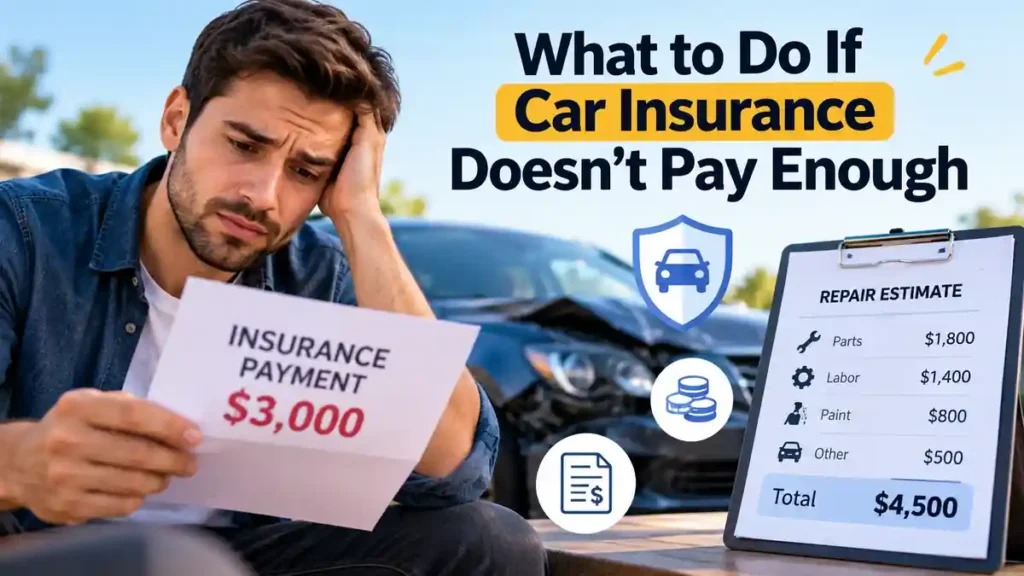
If you’re wondering what to do if car insurance doesn’t pay enough, you’re not alone. Your insurer may offer less than your repair costs, undervalue your totaled car, or pay only up to the at-fault driver’s policy limits. Fortunately, you may have options to challenge a low payment. Learn how to review your insurance estimate, gather supporting evidence, negotiate a settlement, and explore coverage options under your policy and state law.
Why Is My Car Insurance Not Paying Enough?
Several factors can explain why your insurance payment is lower than expected:
- Low repair estimate: The initial inspection may miss hidden damage or underestimate labor and parts costs.
- Incorrect total-loss valuation: The insurer may have inaccurate vehicle details or unsuitable comparable vehicles.
- Deductible: Your share of a covered claim reduces the amount the insurer pays.
- Coverage limits or exclusions: Your policy may not cover the entire loss.
- Insufficient insurance: The at-fault driver’s liability limit may be too low to cover all your damage.
Identifying the specific reason helps you choose the right next step.
What to Do If Car Insurance Doesn’t Pay Enough for Repairs
If your repair shop says the insurer’s estimate is too low, follow these steps.
1. Get a Detailed Repair Estimate
Ask a reputable auto body shop to inspect your vehicle and prepare an itemized estimate. Hidden damage to structural components, wiring, or safety systems may become visible only after repairs begin.
2. Compare Both Estimates
Compare the insurer’s estimate with the shop’s estimate. Look for missing repairs, differences in labor hours, parts prices, paintwork, and repair procedures.
3. Request a Supplemental Estimate
If the shop discovers additional damage, ask it to document the findings with photographs and itemized costs and submit a supplemental estimate to the insurer.
Example: The insurer approves $3,000 in repairs, but the shop estimates $4,500 after discovering hidden damage. The shop can request an additional $1,500. The insurer must review the supplement; approval is not automatic.
4. Ask for a Written Explanation
If the insurer rejects certain repairs, ask which items were denied and why. Provide technical documentation from the repair shop and request a supervisor review if necessary.
What to Do If Your Total-Loss Settlement Is Too Low
When an insurer declares your vehicle a total loss, the settlement is generally based on its actual cash value (ACV) immediately before the accident, subject to your policy and state law. ACV is not necessarily the same as the cost of buying a replacement vehicle.
Review your valuation report for errors involving:
- Vehicle year, make, model, and trim
- Mileage and pre-accident condition
- Optional features and equipment
- Comparable vehicles and valuation adjustments
Look for similar vehicles in your local market and save listings showing their prices, mileage, and specifications. If you find errors in the insurer’s report, submit supporting evidence and request a revised valuation.
You can also ask whether your policy includes an appraisal process for disputed values.
What about GAP insurance? If your loan balance exceeds the insurance settlement, eligible GAP coverage may help cover the difference, depending on the contract. For example, a $16,000 loan balance and a $12,000 settlement leave a $4,000 gap. GAP insurance does not automatically increase your car’s actual cash value.
What If the Other Driver’s Insurance Limit Is Too Low?
If another driver caused the accident but their property-damage liability coverage cannot cover all your losses, consider these options:
- Your collision coverage: It may pay for covered vehicle damage, subject to your deductible.
- Underinsured motorist property-damage coverage: This may help in eligible situations, but availability and requirements vary by state and policy.
- Subrogation: Your insurer may seek reimbursement from the responsible party and may recover your deductible if successful.
- Legal advice: An attorney can explain whether pursuing the at-fault driver for remaining losses is practical.
Contact your insurer to confirm which options apply to your situation.
How to Dispute a Low Car Insurance Settlement
A well-documented dispute gives the insurer a clear reason to reconsider its decision.
- Request a written explanation of the payment.
- Review your policy, deductible, limits, and exclusions.
- Collect repair estimates, photographs, receipts, and valuation evidence.
- Send a written dispute identifying specific errors and requested corrections.
- Ask a claims supervisor to review unresolved disagreements.
- Consider contacting your state’s Department of Insurance if you suspect improper claim handling.
- Consult an attorney if the dispute involves substantial losses, serious injuries, or complicated legal questions.
Keep copies of all correspondence and check applicable policy and legal deadlines.
Can You Cash an Insurance Check and Still Ask for More Money?
It depends on the payment terms, claim type, any signed release, and state law. Some checks cover an initial payment, while other documents may establish a full-and-final settlement.
Before accepting a settlement, review the paperwork carefully. If you have already cashed the check, do not assume you automatically lose all rights to additional payment—or that you can always request more. Ask the insurer about supplemental payments and seek legal advice if the settlement terms are unclear.
How to File a Complaint Against a Car Insurance Company
If you cannot resolve the dispute directly, you may file a complaint with your state’s Department of Insurance. Prepare your claim number, policy documents, settlement offer, estimates, supporting evidence, and written communications.
The regulator may review potential violations of insurance requirements, but filing a complaint does not guarantee a higher settlement. Find your state’s regulator through the NAIC consumer insurance resources.
Frequently Asked Questions
Can I negotiate a car insurance settlement?
Yes. You can request a review and provide evidence supporting a higher payment, but an increase is not guaranteed.
Does insurance have to pay the full repair estimate?
Not necessarily. The insurer may review whether repairs and costs are supported and covered under the applicable policy or claim.
How long do I have to dispute a settlement?
Deadlines vary depending on state law, policy terms, and claim type. Review your documents and seek advice promptly if necessary.
Should I hire a lawyer for a low settlement?
Consider legal advice if the amount is substantial, liability is disputed, serious injuries are involved, or important legal deadlines may apply.
Final Thoughts
If your car insurance doesn’t pay enough, identify why the payment falls short, request a written explanation, and gather evidence supporting your position. You may be able to challenge an incomplete repair estimate, an inaccurate total-loss valuation, or a coverage decision.
Your options depend on your policy, the evidence, and state law. A low initial offer does not automatically mean the insurer acted improperly, and disputing a payment does not guarantee additional money.
Read Also:-Does Car Insurance Pay for Death