
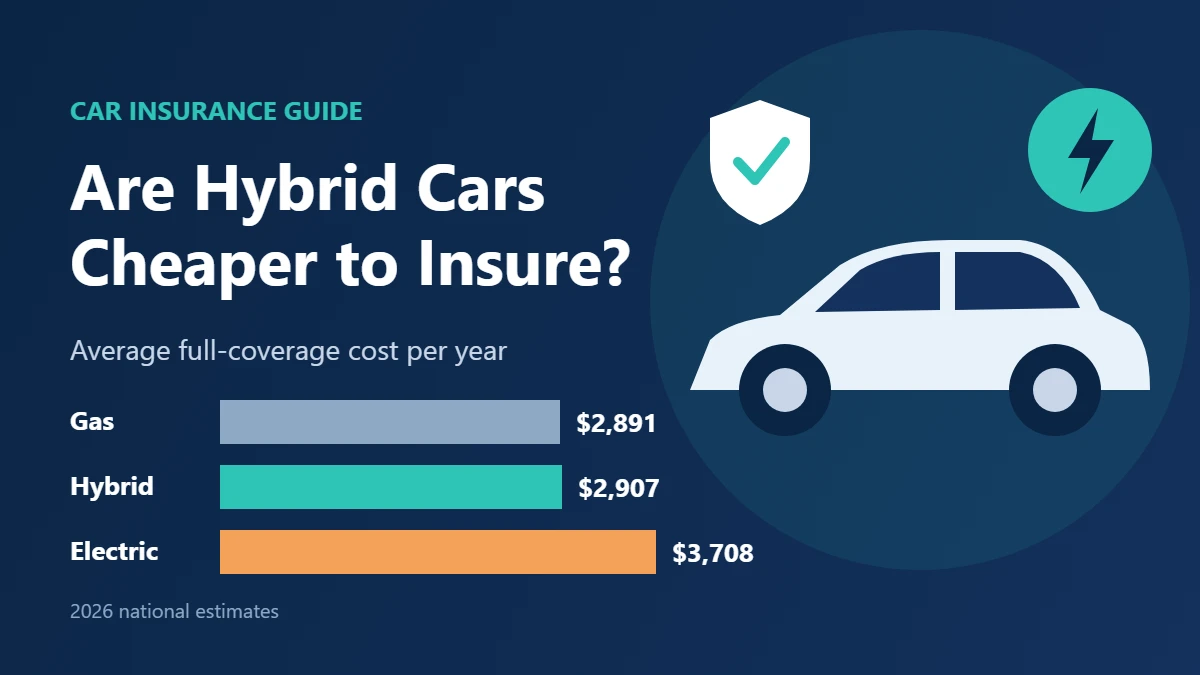
If you’re choosing between a hybrid and a gas car, insurance is an easy cost to overlook until the first quote arrives. The short answer: on average, hybrids are not cheaper to insure, but they are barely more expensive. National 2026 estimates put the gap at about $16 a year, and several large insurers actually charge less for hybrids than for gas cars.
The model you pick and the company you buy from matter far more than the powertrain. Below are the real numbers, why insurers price hybrids this way, the cheapest models to cover, and how to compare quotes.
How Much More Does It Cost to Insure a Hybrid?
According to Insurance.com’s 2026 rate analysis, full coverage averages about $2,907 a year for a hybrid, $2,891 for a gas-powered car, and $3,708 for an electric vehicle. That’s a hybrid-versus-gas difference of roughly 0.6%, or about $1.33 a month.
Those averages are based on a 40-year-old driver with a clean record, good credit, and full coverage with 100/300/100 liability limits and $500 deductibles. Your own rate will differ, but the takeaway holds: for most drivers, choosing a hybrid won’t meaningfully raise insurance costs.
Older data showed a larger gap: 2023–2024 comparisons of gas and hybrid versions of the same model often found hybrids costing 1% to 7% more. Current pricing suggests that gap has narrowed for many popular models.
Some Insurers Charge Less for Hybrids
Averages hide a useful detail. In the same dataset, five of eight major insurers charged less, on average, for hybrids than for gas cars:
| Insurer | Hybrid | Gas | Hybrid vs. gas |
|---|---|---|---|
| Allstate | $3,723 | $3,801 | $78 less |
| Travelers | $1,912 | $1,956 | $44 less |
| GEICO | $2,404 | $2,430 | $26 less |
| State Farm | $2,481 | $2,505 | $24 less |
| Progressive | $2,688 | $2,697 | $9 less |
| Farmers | $3,834 | $3,817 | $17 more |
| Nationwide | $2,645 | $2,614 | $31 more |
| USAA | $2,200 | $2,059 | $141 more |
Notice that the spread between insurers (more than $1,900 a year from Travelers to Farmers) dwarfs the spread between hybrid and gas. Whether a hybrid is “cheaper to insure” depends heavily on which company you ask.
Why Hybrids Can Cost More to Insure
Insurers don’t price by fuel type. As the Insurance Information Institute explains, premiums are based in part on a car’s price, its cost to repair, its overall safety record, and the likelihood of theft. Hybrids can score worse on a few of those:
- Higher sticker price. The hybrid version of a model usually costs more than the gas version, which raises the payout if the car is totaled or stolen.
- Specialized repairs. High-voltage systems and hybrid-specific parts can require trained technicians, which may push collision claims higher.
- Theft of parts. According to the Insurance Institute for Highway Safety, older Toyota Prius models have been targeted for catalytic converter theft, which shows up in comprehensive claims.
Why Many Hybrids Are Still Cheap to Insure
Price isn’t the whole story. The National Association of Insurance Commissioners says the single greatest influence on rating is claim frequency, and that luxury and sports cars average more claims. Most popular hybrids are practical commuter cars and family SUVs, so they tend to generate ordinary claim patterns. That keeps their premiums close to, or below, their gas counterparts.
Cheapest and Most Expensive Hybrids to Insure
Insurance.com’s 2026 full-coverage estimates show how much the model matters:
| Cheapest hybrids | Avg. yearly cost | Most expensive hybrids | Avg. yearly cost |
|---|---|---|---|
| Toyota RAV4 Hybrid | $2,499 | Chevrolet Corvette E-Ray | $4,802 |
| Toyota Corolla Cross Hybrid | $2,500 | Porsche Cayenne Hybrid | $4,654 |
| Honda CR-V Hybrid | $2,506 | BMW X5 (hybrid) | $3,697 |
| Ford Escape Hybrid | $2,535 | Toyota Crown | $3,360 |
| Kia Niro Hybrid | $2,560 | Toyota Prius | $2,930 |
The pattern is simple: a mainstream hybrid SUV costs less than the average car to insure, while a performance or luxury hybrid costs as much as any premium vehicle. Before you buy, you can see how a specific model’s claim history compares with other vehicles using the IIHS insurance loss data by make and model.
Plug-In Hybrids and Battery Coverage
Plug-in hybrids (PHEVs) have larger batteries and usually higher prices than standard hybrids, so their collision and comprehensive costs tend to run higher. If you’re deciding between the two, quote both.
A common worry is the battery. Your policy covers battery damage caused by a covered event: collision coverage for a crash, and comprehensive coverage for events like flood, fire, or theft. It doesn’t pay for normal wear or gradual loss of capacity. That’s what the automaker’s hybrid battery warranty is for, and it typically runs longer than the basic warranty. Check the exact terms for your model before you buy.
How to Compare Hybrid and Gas Quotes the Right Way
- Quote the exact trims. Compare the specific hybrid and gas versions you’d actually buy, using the VIN when you can.
- Keep coverage identical. Use the same liability limits, deductibles, and add-ons, or the comparison means nothing.
- Get at least three quotes. The insurer table above shows how far apart companies can be for the same type of car.
- Ask about green vehicle discounts. According to Insurance.com, insurers such as Travelers, GEICO, Nationwide, and USAA offer hybrid or eco-friendly vehicle discounts in some states, worth around 10% where available.
- Review your deductible. Raising collision and comprehensive deductibles from $200 to $500 can cut those costs by 15% to 30%, per the Insurance Information Institute. Only choose an amount you could pay tomorrow.
- Check multi-car options. If the hybrid will join another vehicle on your policy, see whether adding a second car to your insurance beats a separate policy.
Remember that the car is only part of your rate. Factors like your location, driving record, and even your occupation can move your premium more than the hybrid badge does.
The Bottom Line
Hybrid cars aren’t automatically cheaper to insure, but the difference is now small: about $16 a year on average, and five of eight major insurers in the 2026 data charged less for hybrids than for gas cars. A mainstream hybrid like a RAV4, CR-V, or Corolla Cross is among the cheaper vehicles to cover, while luxury and performance hybrids cost much more. Pick your model with insurance in mind, compare at least three quotes for the exact trim, and ask every insurer about green vehicle discounts.