
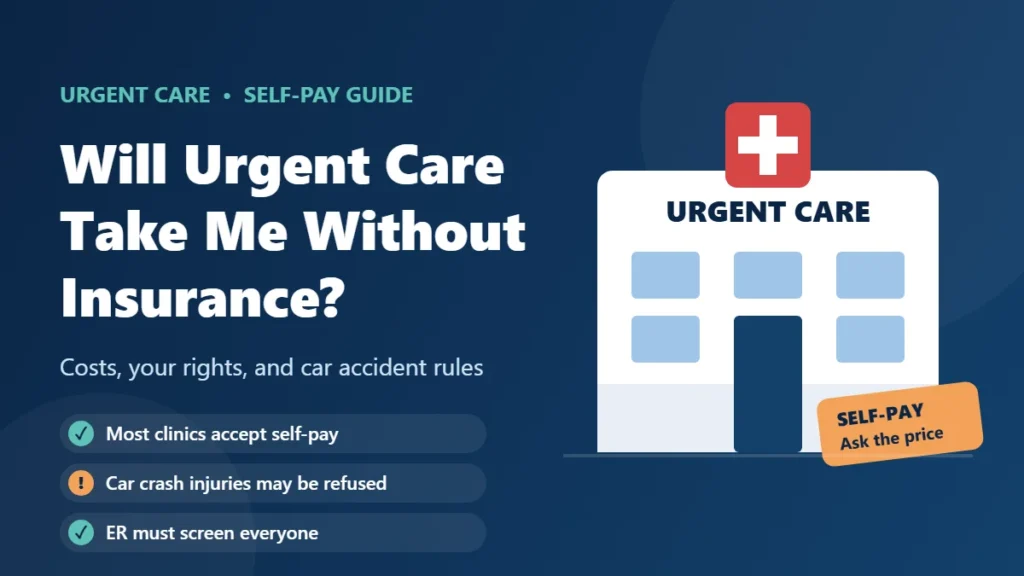
Yes, most urgent care clinics will see you without insurance. You simply become a “self-pay” patient, which usually means paying for the visit at the front desk before you leave. The catch is that an urgent care center is a private business, not an emergency room. It can turn you away if you can’t pay, if it doesn’t offer the care you need, or, in a situation many people don’t expect, if your injury came from a car accident.
Below: when a clinic can say no, what self-pay visits cost, how crash injuries are handled, and where to go if you’re refused.
Why Urgent Care Can Say No (and the ER Can’t)
Hospital emergency departments that receive Medicare funds, which includes most U.S. hospitals, must follow a federal law called the Emergency Medical Treatment and Labor Act (EMTALA). Under it, the ER must give you a medical screening exam and treatment to stabilize an emergency condition, whether or not you have insurance or can pay. CMS lays out these emergency room rights in plain language.
Standalone urgent care centers aren’t bound by EMTALA. They set their own payment rules, which commonly include:
- Payment, or a deposit, at check-in or before you leave
- Accepting only certain insurance plans or payment methods
- Declining patients who have unpaid past balances
- Sending you elsewhere if they lack the equipment or staff for your condition
Still, most clinics welcome self-pay patients because they pay right away, so being uninsured rarely gets you refused on its own.
What a Self-Pay Urgent Care Visit Costs
Published self-pay prices for a basic visit generally run from about $100 to $300, depending on the clinic and where you live. Tests and procedures are where bills grow. As one real example, MedStar Health’s posted urgent care self-pay fee schedule lists $295 for a visit that includes an X-ray, lab work, an EKG, or stitches. It also notes that outside labs, off-site imaging, splints and crutches, and prescriptions are billed separately.
Before you’re seen, ask the front desk:
- What does the basic self-pay visit include?
- What would an X-ray, a strep test, or stitches add?
- Is there a discount for paying in full today?
- Do you offer a payment plan?
- Will an outside lab or radiologist bill me separately later?
You Can Ask for a Written Estimate
Under the federal No Surprises Act, uninsured and self-pay patients can get a good faith estimate when they schedule care at least three business days ahead or when they ask for one. If the final bill comes in at least $400 above that estimate, you may be able to dispute it, according to CMS. Walk-in visits usually fall outside the scheduling rule, but you can still ask.
Car Accident? Urgent Care May Refuse You for a Different Reason
Many urgent care centers won’t treat car accident injuries at all, even for patients who have health insurance. The reason is billing. Crash injuries are often paid through an auto insurance claim that can take months to settle, and clinics running on thin margins don’t want to wait.
In one case reported by KFF Health News, an 18-year-old in Georgia with a headache after a rollover was told by an urgent care receptionist, “We don’t take third-party insurance,” and sent to a nearby ER. That bill started at $17,005. The head of the Urgent Care Association told the outlet that urgent care centers generally don’t take car accident patients for this reason.
If you’ve been in a crash:
- Call ahead and ask directly: “Do you treat auto accident injuries, and how would I pay?”
- Offer to pay as self-pay. Some clinics that won’t bill an auto claim will still see you if you pay at the visit. Keep the receipt and an itemized bill.
- Check your own auto policy. Personal injury protection (PIP), required in no-fault states, and optional medical payments coverage (MedPay) pay your medical bills no matter who caused the crash. You can submit urgent care receipts to your insurer for reimbursement. Our guide to how health insurance and PIP work after a Florida crash shows how these coverages fit together.
- Report the accident promptly. Late notice can complicate your claim, so check how long you have to report a car accident to insurance.
In at-fault states like Georgia, the other driver’s insurer may repay you later, so keep every receipt.
Important: Severe pain, numbness, confusion, chest pain, trouble breathing, or any head injury with vomiting or drowsiness belongs in the ER, or call 911. Never delay emergency care because of insurance worries.
Where to Go If Urgent Care Won’t See You
- Another urgent care center. Policies vary widely, so call before you drive over.
- A community health center. These federally funded clinics charge based on your income. HealthCare.gov’s community health center page links to a locator for finding one near you.
- Telehealth. For colds, rashes, pink eye, or urinary symptoms, a video visit often costs less. Confirm the price before you start.
- The emergency room. For anything serious, the ER must screen and stabilize you. You’ll still get a bill, so ask about the hospital’s financial assistance (charity care) program.
Consider Getting Covered
If you’re uninsured, you can usually enroll in a Marketplace health plan during Open Enrollment, which runs from November 1 to January 15 on HealthCare.gov (some state marketplaces set different dates). Outside that window, a qualifying life event, such as losing job-based coverage, moving, or having a baby, can open a 60-day Special Enrollment Period. Medicaid accepts applications year-round.
Frequently Asked Questions
Do urgent care clinics make you pay up front without insurance?
Usually, yes: at check-in or before you leave. Some clinics bill later or offer payment plans, so ask first.
Is urgent care cheaper than the ER without insurance?
For minor problems, almost always. An ER visit for the same issue, especially one with imaging, can cost many times more.
The Bottom Line
Urgent care will almost always take you without insurance if you can pay the self-pay price. Call ahead and ask what’s included. If you were hurt in a car accident, confirm the clinic treats crash injuries and lean on your PIP or MedPay coverage. For anything that looks like an emergency, go straight to the ER.