
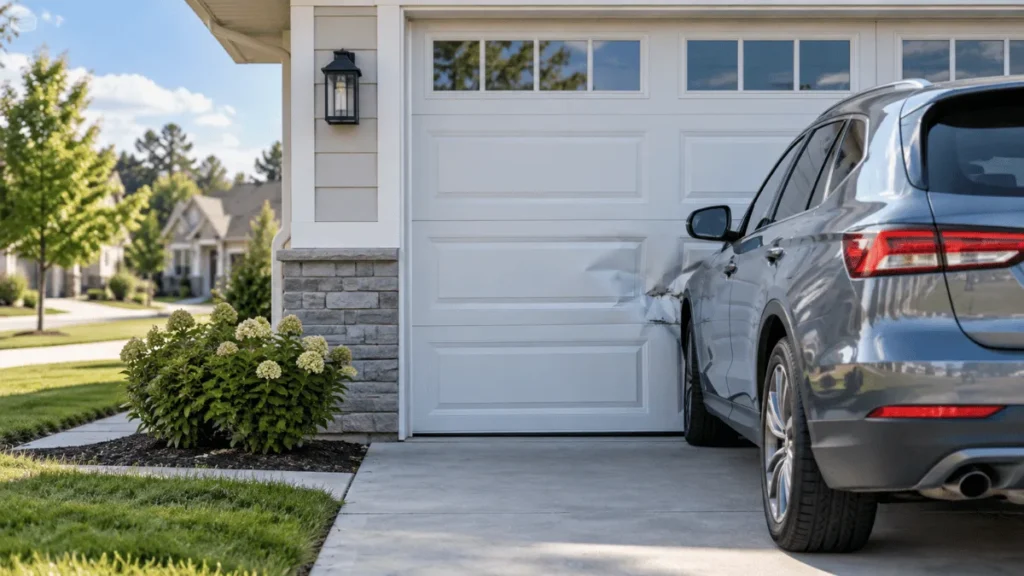
Accidentally backing into a garage door can leave you wondering, does homeowners insurance cover garage door damage by your car? In many cases, homeowners insurance may cover damage to your own garage door, while auto insurance may handle damage to your vehicle. However, coverage depends on your policy, deductible, exclusions, and the circumstances of the accident.
Does Homeowners Insurance Cover a Garage Door You Hit With Your Car?
If you accidentally hit your own garage door with your car, your homeowners insurance may cover the garage-door damage if the loss is covered by your policy.
The important distinction is that your garage and your vehicle are different types of property. Homeowners insurance may address damage to the home, while your auto policy may cover your vehicle through collision coverage.
Coverage is not guaranteed. Your policy terms, covered causes of loss, exclusions, coverage limits, and deductible all matter. Sudden accidental damage is also different from problems caused by normal wear and tear, aging, rust, poor maintenance, or mechanical failure.
Example: You back into your attached garage door and damage several panels. Your homeowners policy may cover the garage-door damage, subject to your deductible and policy terms. If your car is also damaged, collision coverage may apply separately.
Which Insurance Pays for the Damage?
The answer depends on what was damaged and who owns the property.
| Situation | Insurance that may apply |
| You hit your own garage | Homeowners insurance |
| Your car is damaged | Auto collision coverage |
| You hit someone else’s garage | Auto property-damage liability |
| Someone else hits your garage | At-fault driver’s liability |
| Detached garage is damaged | Other Structures coverage may apply |
Homeowners Insurance for the Garage
An attached garage is generally considered part of the home’s dwelling, commonly covered under Coverage A. A detached garage generally falls under Other Structures (Coverage B).
Your homeowners deductible generally applies to a covered claim. Check your declarations page for your coverage limits and deductible before deciding whether to file.
Auto Insurance for Your Car
If your vehicle is damaged when you hit the garage, collision coverage may help pay for repairs, subject to your auto deductible and policy terms.
If you do not have collision coverage, your auto policy generally will not pay for your own vehicle’s collision damage.
Auto Liability for Someone Else’s Garage
If you accidentally hit a neighbor’s garage, your auto property-damage liability coverage may pay for damage you are legally responsible for, subject to your policy limits and applicable law.
Auto liability generally does not cover damage to your own garage because liability coverage is intended to protect against damage to other people’s property.
What If Your Car and Garage Door Are Both Damaged?
You may potentially have two separate claims: homeowners insurance for the garage and auto collision coverage for the vehicle.
For example:
- Garage damage: $3,000
- Homeowners deductible: $1,000
- Car damage: $4,000
- Collision deductible: $500
If both losses are covered, you could potentially receive $2,000 toward the garage and $3,500 toward the car. That means $1,500 in total deductibles.
The actual payment depends on both policies and how the losses are adjusted.
How Much Will Homeowners Insurance Pay?
Your insurance payment depends on the covered damage, deductible, policy limits, and whether the garage door can be repaired or needs replacement.
For example, if covered damage is $3,000 and your homeowners deductible is $1,000, the potential covered amount would be $2,000.
If repairs cost less than your deductible, your insurer may pay nothing.
An insurer also does not automatically replace an entire garage door. A professional may determine that only a panel, track, frame, spring, cable, or another component needs repair.
Should You File a Homeowners Insurance Claim?
Before filing, compare the repair estimate with your deductible.
A claim may make more sense when:
- Damage is substantial
- Repair costs significantly exceed your deductible
- Structural damage is involved
- Full replacement may be necessary
Paying out of pocket may be worth considering when the damage is minor or the repair cost is below or only slightly above your deductible.
Also consider your claims history and the possibility that a claim could affect future underwriting or insurance costs. A premium increase is not automatic, and insurer practices vary by state and company.
What Garage Door Damage Is Usually Not Covered?
Homeowners insurance generally does not cover routine maintenance problems simply because the garage door needs repair. Examples may include:
- Normal wear and tear
- Rust or corrosion
- Aging components
- Old or broken springs
- Mechanical failure
- Poor maintenance
- Pre-existing damage
- Intentional damage
The key difference is accidental vehicle impact versus gradual deterioration.
What If Someone Else Hits Your Garage?
If another driver hits your garage and is legally responsible, their auto property-damage liability coverage may pay for the damage, subject to their policy limits and applicable law.
Your homeowners insurance may also potentially apply depending on your policy and circumstances. If your insurer pays a covered loss, it may seek reimbursement from the responsible party’s insurer through subrogation.
If the driver is uninsured, check your homeowners policy rather than assuming auto uninsured-motorist coverage will cover the garage.
What Should You Do After Hitting Your Garage Door?
- Stop the vehicle and make sure it is safely positioned.
- Check for hazards, such as loose panels, damaged tracks, springs, or cables.
- Do not force the garage door open or closed if it appears unstable.
- Take photos of the garage, vehicle, and surrounding damage.
- Get a professional repair estimate.
- Check your homeowners deductible and auto collision deductible.
- Review your policies to understand applicable coverage.
- Contact your insurer if the damage is significant or you need clarification.
Frequently Asked Questions
Does homeowners insurance cover garage door damage by your car?
Yes, it may cover accidental damage to your own garage door caused by your car, depending on your policy, deductible, exclusions, and circumstances.
Does car insurance cover hitting your own garage door?
Auto liability generally does not cover your own garage. Homeowners insurance may cover the garage, while collision coverage may cover damage to your vehicle.
Does homeowners insurance cover a detached garage?
A detached garage generally falls under Other Structures (Coverage B), subject to your policy limits, deductible, exclusions, and terms.
Will insurance replace my entire garage door?
Not necessarily. The insurer may evaluate whether the damaged door or individual components can be repaired instead of replaced.
Bottom Line
If you accidentally hit your own garage door, homeowners insurance may cover the garage damage, while auto collision coverage may cover damage to your car. If you damage someone else’s garage, your auto property-damage liability coverage may apply.
Before filing a claim, get a repair estimate, compare it with your deductible, and review your policy. Your actual coverage depends on the terms of your homeowners and auto insurance policies and, in some situations, state law.
Read Also:-Can You Register a Car Without Insurance in Florida