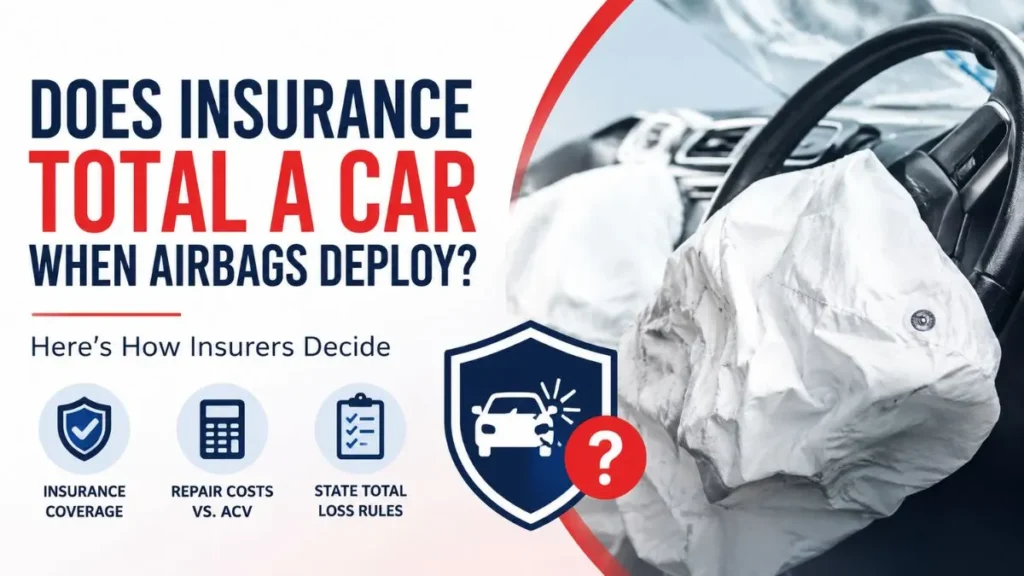
After a car accident, one of the first questions many drivers ask is, does insurance total a car when airbags deploy? The short answer is no—not always. While deployed airbags can significantly increase repair costs, they don’t automatically mean your vehicle is a total loss. Insurance companies evaluate your car’s Actual Cash Value (ACV), total repair costs, state total loss laws, and the overall extent of the damage before making a decision. Here’s how the process works.
Does Insurance Total a Car When Airbags Deploy?
No, insurance does not automatically total a car when airbags deploy. Airbag deployment is only one factor insurers consider after an accident. Instead, they compare the total repair costs—including airbags, sensors, labor, and structural damage—with your vehicle’s Actual Cash Value (ACV). If repairing the vehicle isn’t financially practical or exceeds your state’s total loss threshold, it may be declared a total loss. Otherwise, the insurance company will usually approve repairs.
How Insurance Companies Decide Whether to Total a Car
Insurance companies follow a structured process instead of making decisions based solely on airbag deployment.
Determine the Actual Cash Value (ACV)
The insurer calculates your car’s market value immediately before the accident by considering its age, mileage, condition, features, and local market prices.
Estimate the Total Repair Costs
The repair estimate includes more than replacing the airbags. It may also cover frame repairs, suspension components, seat belt pretensioners, crash sensors, dashboard replacement, paintwork, replacement parts, and labor.
Apply State Total Loss Rules
Some states use a Total Loss Threshold (TLT), while others follow a Total Loss Formula (TLF). The insurer applies the rule required in your state before making a final decision.
Compare Repair Costs With Vehicle Value
If repairing the vehicle costs more than it’s worth—or exceeds the applicable threshold—the insurer will usually declare it a total loss. Otherwise, the vehicle is typically repaired.
Why Airbag Repairs Are So Expensive
Replacing a deployed airbag is rarely the only repair required. Modern airbag systems include several safety components that often need replacement after a collision, such as:
- Driver and passenger airbags
- Side or curtain airbags
- Dashboard or steering wheel
- Seat belt pretensioners
- Crash sensors
- Airbag control module
When labor, diagnostics, and structural repairs are added, the total repair bill can quickly reach several thousand dollars, making a total loss more likely for older vehicles.
When Is a Car More Likely to Be Totaled?
Your vehicle is more likely to be declared a total loss if it has:
- A low Actual Cash Value (ACV)
- Multiple deployed airbags
- Significant frame damage
- Major suspension or engine damage
- Extensive electrical system damage
- Repair costs that exceed the state’s total loss threshold
Older vehicles are especially at risk because their market value is often much lower than the cost of repairs.
When Can a Car Still Be Repaired?
Even with deployed airbags, many vehicles can still be repaired if:
- The vehicle is relatively new.
- It has a high market value.
- Structural damage is minor.
- Only one airbag deployed.
- Total repair costs remain below the applicable threshold.
A professional inspection determines whether repairing the vehicle is both safe and financially reasonable.
Does Insurance Pay to Replace Deployed Airbags?
Whether insurance pays depends on your coverage.
| Coverage Type | Airbag Replacement |
|---|---|
| Collision Coverage | ✅ Usually covered after a collision |
| Comprehensive Coverage | ✅ Covered for eligible non-collision events |
| Liability-Only Insurance | ❌ Doesn’t cover your own vehicle |
What Happens If Your Car Is Declared a Total Loss?
If the insurer totals your vehicle, the process generally includes:
- Vehicle inspection
- Damage estimate
- ACV calculation
- Settlement offer
- Deductible applied (if required)
- Salvage title issued
- Insurance payment after the claim is finalized
In many states, you can choose owner retention, which allows you to keep the vehicle after accepting a reduced settlement. The car will usually receive a salvage title and may need inspections before returning to the road.
Can You Drive After the Airbags Deploy?
Driving immediately after airbag deployment isn’t recommended. Hidden structural damage, damaged safety systems, or warning lights may indicate that the vehicle isn’t safe to operate. Always have the car inspected and repaired by a qualified technician before driving it again.
Real-Life Examples
Older Sedan: A 2013 sedan worth $6,000 suffers front-end damage with multiple deployed airbags. Estimated repairs total $6,800, so the insurer will likely declare it a total loss.
New SUV: A 2025 SUV worth $42,000 has one deployed airbag and repair costs of $10,500. Since the repairs are well below its value, the insurer will usually approve repairs.
Frequently Asked Questions
Does airbag deployment automatically total a car?
No. Insurance companies compare repair costs with your vehicle’s Actual Cash Value (ACV) before making a decision.
How much does it cost to replace airbags?
Costs vary by vehicle and the number of airbags deployed, but replacing multiple airbags and related safety components can cost several thousand dollars.
Can a car be repaired after airbags deploy?
Yes. Many vehicles can be safely repaired if the overall damage is limited and repair costs remain below the insurer’s total loss threshold.
Can I keep my totaled car?
In many states, yes. This is known as owner retention, although salvage and rebuilt title requirements vary by state.
Final Verdict
Does insurance total a car when airbags deploy? Not automatically. Airbag deployment increases repair costs, but insurers base their decision on your vehicle’s Actual Cash Value (ACV), total repair costs, state regulations, and the overall damage. While older, lower-value vehicles are more likely to be totaled, many newer vehicles with deployed airbags can still be safely repaired. The best approach is to wait for the insurance adjuster’s inspection before assuming your car is a total loss.