
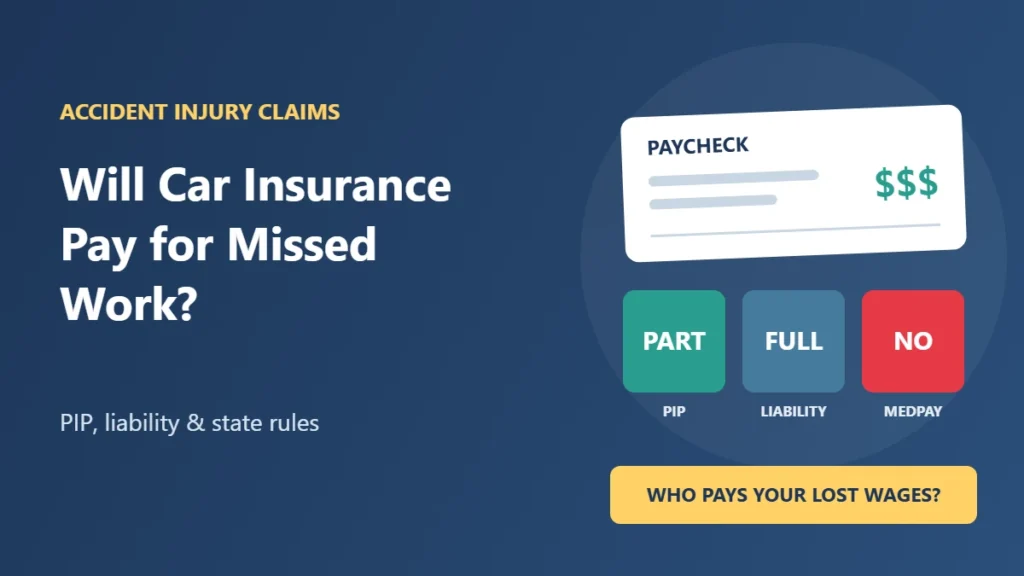
Yes, car insurance can pay for missed work after an accident, but it depends on which coverage applies. Personal injury protection (PIP) on your own policy can replace part of your lost income no matter who caused the crash. If another driver was at fault, you can claim your full lost wages from their liability insurance. Medical payments coverage (MedPay), on the other hand, is built to pay medical bills, not lost income.
Below, you’ll see how much each coverage pays, the rules in Florida, New York, and Texas, and how to prove your claim.
Which Coverage Pays Lost Wages?
| Coverage | Pays lost wages? | How much |
|---|---|---|
| Your PIP | Yes, regardless of fault | A set percentage of income, up to your policy limit |
| At-fault driver’s bodily injury liability | Yes, if they caused the crash | Your actual lost income, up to their policy limit |
| Your uninsured/underinsured motorist coverage | Often, if the at-fault driver lacks enough insurance | Depends on your policy and state |
| Your MedPay | Generally no | Medical bills only |
The Texas Department of Insurance explains the difference: MedPay pays medical bills, while PIP also pays for things like lost wages and other nonmedical costs.
How Much PIP Pays in Three States
Florida
Under section 627.736 of the Florida Statutes, PIP pays 60% of lost gross income and earning capacity when you can’t work because of your injuries. That’s part of a $10,000 limit shared with medical benefits, and disability benefits must be paid at least every two weeks. If PIP medical bills use up most of the $10,000, little may be left for wages.
New York
According to the New York Department of Financial Services, basic no-fault coverage pays 80% of lost earnings, up to $2,000 per month, for up to three years from the accident. It’s part of $50,000 in basic no-fault coverage per person and is reduced by certain state disability, workers’ compensation, and Social Security disability benefits.
Texas
Texas policies include PIP unless you reject it in writing. Under Insurance Code § 1952.151, PIP replaces income lost because of the accident for people who were earning income. Insurers aren’t required to provide more than $2,500 per person for all PIP benefits combined, though you can often buy more. That means a single trip to the emergency room can use up much of the basic amount.
Two Quick Examples
New York: You earn $4,000 a month and miss two months of work. Eighty percent of your earnings is $3,200, but no-fault caps lost earnings at $2,000 a month, so it pays up to $4,000 total, before any offsets. You could claim the remaining $4,000 from the at-fault driver if someone else caused the crash.
Florida: You earn $1,000 a week and miss three weeks. PIP pays 60%, or $600 a week, for $1,800, as long as your $10,000 PIP limit hasn’t already been used up by medical bills.
Claiming Lost Wages From the At-Fault Driver
If someone else caused the crash, their bodily injury liability coverage can pay your lost income in full, up to their policy limits. This can include:
- Regular wages or salary
- Overtime you would have worked
- Commissions, tips, and bonuses you can document
- In many cases, sick days or vacation time you used to cover the absence
- Reduced future earning ability, if your injury is long-term
If you already received PIP, the at-fault driver’s claim generally covers what PIP didn’t. If the other driver has no insurance or too little, your uninsured or underinsured motorist coverage may step in. See whether you can sue someone for not having car insurance.
What If You Don’t Earn a Paycheck?
Stay-at-home parents, retirees, and students may not have wages to replace, but they may still have a claim. In Texas, for example, PIP reimburses people who weren’t earning income for reasonable expenses for essential services they normally perform for their household, such as childcare or housework. Self-employed workers can usually claim lost business income, but they need stronger proof.
How to Prove Your Lost Wages
- Get a doctor’s note stating that you can’t work and for how long. Insurers can require reasonable medical proof of the injury causing your lost income.
- Get an employer letter confirming your job, pay rate, normal hours, and the dates you missed.
- Gather pay records, such as recent pay stubs and W-2s.
- If self-employed, provide tax returns, invoices, client cancellations, and profit-and-loss statements.
- Track every missed day, including partial days for medical appointments.
- Report the crash promptly. See how long to report a car accident to insurance.
Why Lost Wage Claims Get Denied or Reduced
- No medical documentation saying you couldn’t work
- A long gap between the crash and treatment
- Returning to work earlier than your doctor’s note suggests, or doing similar work elsewhere
- Unclear income, especially cash or gig work without records
- Policy limits already used up by medical bills
Frequently Asked Questions
Does car insurance pay for missed work for doctor’s appointments?
It can. PIP and liability claims may include time missed for accident-related treatment if you document it.
Is lost wage compensation taxable?
Tax treatment depends on the type of payment and your situation. Ask a tax professional before filing.
How long does it take to get paid?
PIP usually pays during your recovery. In Florida, disability benefits must be paid at least every two weeks. A liability claim usually pays lost wages as part of a final settlement.
The Bottom Line
Car insurance will pay for missed work in many cases. Your own PIP can cover part of your lost income regardless of fault, and the at-fault driver’s insurer can pay the rest. MedPay generally won’t. Document your income and your doctor’s restrictions carefully, and check your PIP limits before you need them.