
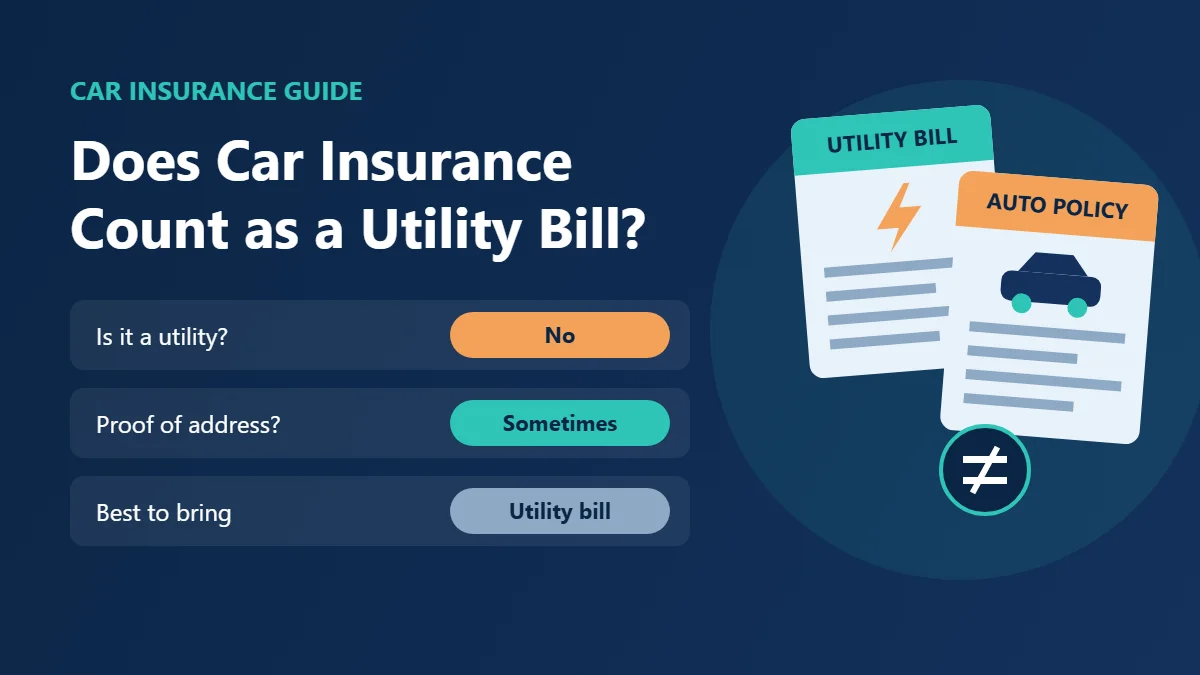
No, car insurance doesn’t count as a utility bill. Utilities are services delivered to your home, such as electricity, gas, and water. Car insurance is a financial product that protects you and your vehicle. Even so, your auto insurance documents can sometimes work as proof of address. Some agencies, including the California DMV, accept vehicle insurance documents alongside utility bills, while others don’t. Always check the specific list of accepted documents before you go.
Here’s the difference and how to use your insurance paperwork when you need to prove where you live.
What Counts as a Utility Bill?
A utility bill is a bill for an essential service supplied to a home or business. Common examples include:
- Electricity
- Natural gas or heating oil
- Water and sewer
- Trash and recycling collection
Many organizations also treat phone, internet, and cable bills as utilities for proof-of-address purposes. California’s DMV, for example, lists a home utility bill or cellular phone bill as a preferred residency document. The U.S. Energy Information Administration’s glossary describes an electric utility as an entity aligned with distribution facilities for delivering electric energy primarily to the public, which shows the core idea: a utility delivers a service through infrastructure to where you live.
Why Car Insurance Isn’t a Utility
Car insurance doesn’t deliver a service to your home. It’s a contract that pays for covered losses, such as damage you cause to others or, with the right coverage, damage to your own car. It’s grouped with other insurance and financial products, not with household utilities.
| Utility bill | Car insurance | |
|---|---|---|
| What it pays for | A service used at your home | Financial protection for you and your vehicle |
| Tied to | A service address | A driver and a vehicle |
| Billing | Usually monthly, based on use | Monthly, semiannual, or annual premium |
| Category | Utility | Insurance |
Paying insurance every month doesn’t change its category. It’s a regular household expense, but not a utility.
Can You Use Car Insurance as Proof of Address?
Sometimes. Whether insurance documents count depends entirely on who’s asking. Here’s how two state DMVs handle residency proof for a REAL ID:
| State | Insurance accepted? | Key rules |
|---|---|---|
| California | Yes, including vehicle insurance documents | Two different printed documents showing your California address |
| New York | Not among the examples listed on its REAL ID page | Two proofs of residency, issued within the past year, no P.O. boxes |
The California DMV REAL ID checklist lists “insurance documents, including medical, dental, vision, life, home, rental or vehicle” as acceptable residency proof. The New York DMV, by contrast, gives examples like a bank statement, pay stub, utility bill, or credit card statement, and won’t accept documents issued more than one year before your visit. So the same insurance card might work in one state and not another.
Banks, landlords, schools, and employers set their own rules too. Some accept any official document with your name and address, while others specifically ask for a utility bill. If you live with family or a roommate and the utilities aren’t in your name, an insurance document in your name can be a helpful option, as long as it’s on the accepted list.
Which Insurance Documents Work Best?
If insurance paperwork is accepted, choose the strongest document:
- Declarations page. It shows your name, address, policy period, and vehicles, so it’s usually the most complete option.
- Billing statement. A recent bill with your name and address can work where statements are accepted.
- Insurance ID card. It may not show your full address, so it’s often the weakest choice.
Make sure the name and address exactly match your application, and print the document if the office requires paper copies. Download a fresh copy from your insurer’s website or app so the date is current.
Make Sure Your Address Is Current
An insurance document only helps if it shows your current address. If you’ve recently moved, update your policy first. Your insurer needs your correct garaging address anyway, since it affects your rate. Learn more about how moving impacts car insurance.
Other Documents That Often Work
If insurance isn’t accepted, these are commonly requested alternatives, depending on the organization:
- Bank or credit card statement
- Pay stub or W-2
- Lease, rental agreement, or mortgage statement
- Property tax bill
- Government mail, such as from the IRS or Social Security
Is Car Insurance a Household Bill?
In everyday budgeting, yes. Car insurance is a recurring household expense, much like rent, phone service, or groceries, and it belongs in your monthly budget. But “household bill” and “utility bill” aren’t the same thing. When a form specifically asks for a utility bill, it usually means a bill for a home service such as electricity, gas, or water. If you’re unsure whether an insurance statement will be accepted, ask before you submit it rather than assuming it qualifies.
Tips Before You Submit Proof of Address
- Get the official list. Check the agency or company website for its accepted documents.
- Check the date rules. Some places, like New York’s DMV, only accept recent documents.
- Match every detail. Your name and address should match your application exactly, including apartment numbers.
- Avoid P.O. boxes unless the list specifically allows them.
- Bring extras. Carry one more document than required in case one is rejected.
- Print when required. Some offices, including California’s DMV, ask for printed documents.
The Bottom Line
Car insurance isn’t a utility bill. Utilities deliver services like power, gas, and water to your home, while car insurance is a financial product. Still, your auto insurance declarations page or statement can sometimes serve as proof of address, as it does at the California DMV. Rules vary by state and organization, so check the accepted documents list first and bring a backup, such as a utility or bank statement.