
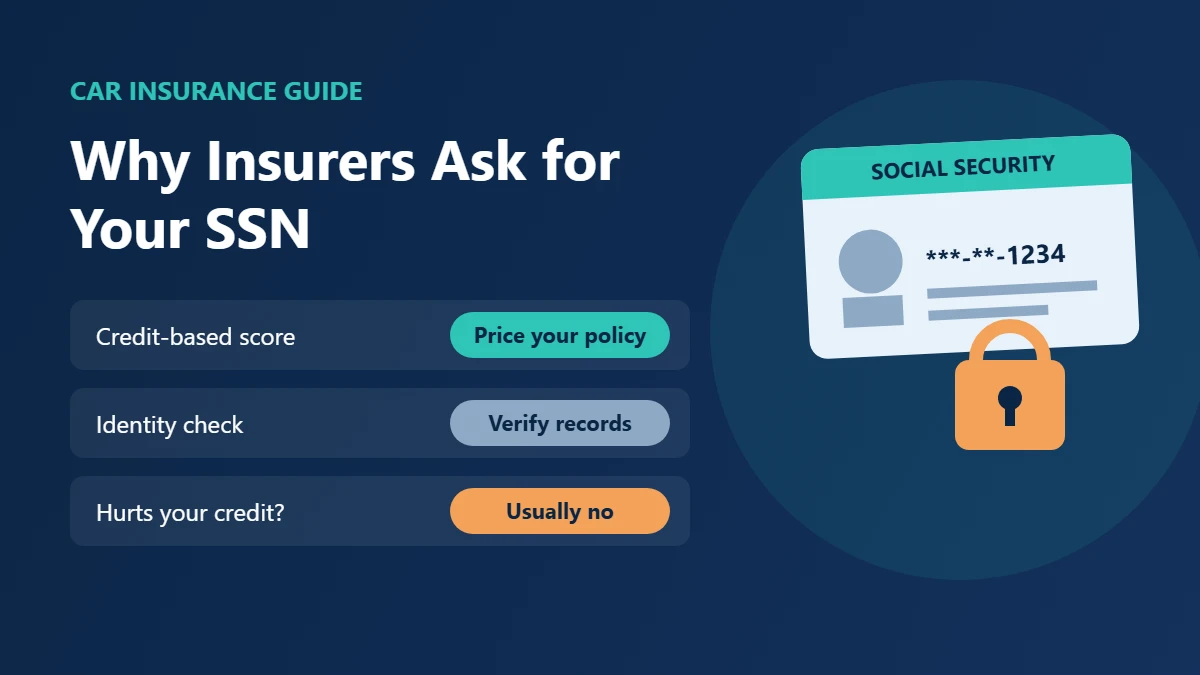
Car insurance companies ask for your Social Security number (SSN) mainly to check your credit history and to verify your identity. In most states, insurers use a credit-based insurance score as one factor in pricing your policy, and your SSN helps them pull the right report. It also helps them match your driving and claims records. Giving your SSN for a quote generally won’t hurt your credit score, and in many cases you can still get coverage without it, though your price may be higher.
Here’s what insurers do with your number and when you can say no.
Reasons Insurers Ask at a Glance
| Reason | What it does |
|---|---|
| Credit-based insurance score | Helps price your policy in states that allow it |
| Identity verification | Confirms you are who you say you are |
| Record matching | Links your driving and claims history to the right person |
| Fraud prevention | Helps flag stolen or false identities |
1. To Check Your Credit-Based Insurance Score
This is the biggest reason. A credit-based insurance score is different from the score a lender uses. According to the National Association of Insurance Commissioners (NAIC), it’s based partly or entirely on your credit history and is used to estimate how likely someone is to file an insurance claim, not how likely they are to repay a loan.
The Insurance Information Institute notes that insurers use credit information with other factors to help underwrite and price policies, typically for personal auto and homeowners insurance. Your SSN helps the insurer pull the correct credit file, especially if you share a name with someone else or have moved often.
2. To Verify Your Identity
An SSN is a reliable way to confirm that the applicant is a real person and that the name, birth date, and address all belong together. This protects the insurer and you from someone buying a policy in your name.
3. To Match Your Driving and Claims Records
Insurers review your past claims and driving history before setting a rate. Your SSN, along with your driver’s license number, helps them find the right records. Accurate matching means you’re not charged for someone else’s accidents or tickets, and you may get credit for a clean history.
4. To Help Prevent Fraud
Insurance fraud raises costs for everyone. Verifying SSNs helps insurers spot fake applications, stolen identities, and people trying to hide a poor claims record under a different name.
Does It Hurt Your Credit Score?
Generally, no. Insurance credit checks are usually soft inquiries. The Consumer Financial Protection Bureau (CFPB) explains that soft inquiries will not affect your credit scores, and they aren’t visible when others buy your credit report. That means you can compare several car insurance quotes without worrying about your score dropping.
Some States Ban Credit-Based Pricing
Not every state lets insurers use credit. NAIC’s Center for Insurance Policy and Research, in an update from January 2024, lists California, Hawaii, Maryland, Massachusetts, Michigan, Nevada, Oregon, and Utah as states that ban insurers’ use of credit-based insurance scores in determining policy rates or offering or renewing a policy. Rules can change, so check with your state insurance department.
Even where credit is allowed, NAIC says that in most states insurers can’t use these scores as the sole reason to raise rates or to deny, cancel, or refuse to renew a policy. Some states also require insurers to notify you when credit information leads to an adverse decision.
Do You Have to Give Your SSN?
Often, no. Many insurers will quote or issue a policy without an SSN, but they may not be able to apply a credit-based score, which can lead to a higher price or fewer discounts. Some companies may require it, so policies vary. If you don’t have an SSN, for example as a new U.S. resident, ask insurers what alternative information they accept.
If you have good credit and live in a state that allows credit-based pricing, sharing your SSN may help you get a lower rate.
Why an Adjuster May Ask After an Accident
You may also be asked for your SSN during a claim, even by the other driver’s insurer. When an injury claim is involved, insurers often need it to meet federal reporting rules, such as checking whether an injured person is a Medicare beneficiary before paying an injury settlement. It can also be needed for tax or lien purposes on certain payments. If an adjuster asks, it’s reasonable to ask which requirement applies and to confirm you’re speaking with the real insurance company before sharing it.
Is It Safe to Share Your SSN?
It’s generally safe with a licensed insurer, but protect yourself:
- Use official channels. Enter your SSN only on the insurer’s secure website, app, or through a licensed agent.
- Watch for scams. Don’t share it in response to unexpected calls, texts, or emails, even if they claim to be from your insurer.
- Ask why. You can ask how the number will be used and how it will be protected.
- Monitor your credit. Review your credit reports regularly for anything you don’t recognize.
What If You Were Denied or Charged More?
If credit played a role, ask the insurer which factors affected your price. Request your credit reports, dispute any errors, and ask for a re-rate once they’re fixed. Shopping around also helps, since every insurer weighs credit differently. If you’ve been non-renewed, see how to get car insurance after non-renewal.
The Bottom Line
Car insurance companies ask for your Social Security number mainly to check your credit-based insurance score, verify your identity, and match your driving and claims records. It generally doesn’t hurt your credit, and several states ban credit-based pricing altogether. You often can get insurance without sharing your SSN, but providing it may help you get a better rate if your credit is strong.