
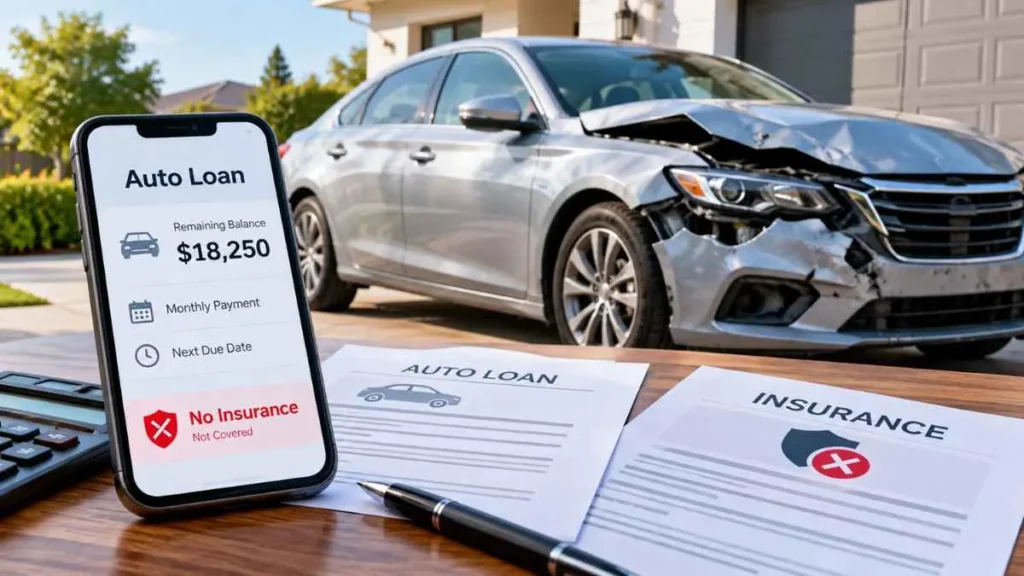
If you’re wondering what happens if you wreck a financed car without insurance, the biggest concern is that your auto loan usually does not disappear. You may still owe the remaining balance even if the vehicle is totaled. You could also face repair or replacement costs, liability for another driver’s damages, and state-specific penalties for driving uninsured.
What Happens to Your Car Loan After an Accident?
A financed car and its loan are two separate things. Damaging or totaling the vehicle does not normally cancel the debt you agreed to repay.
If you still owe money on the car, you generally remain responsible for the unpaid balance under your financing agreement. Your scheduled payments may continue even though the vehicle is no longer drivable.
Do not assume the entire loan becomes due immediately. Whether a lender can accelerate the balance depends on your loan contract and applicable state law.
Contact your lender as soon as possible. Ask for your current payoff balance, whether any lender-placed insurance exists, and what payment options may be available.
What If the Car Is Totaled?
A total loss generally means the vehicle is damaged so severely that repairing it is not economically practical under the applicable insurance or state rules.
Your vehicle’s actual cash value (ACV) and loan balance are different numbers.
For example:
- Remaining loan: $25,000
- Vehicle ACV: $20,000
- Difference: $5,000
If applicable insurance pays $20,000, you could still owe $5,000 unless GAP coverage applies.
Without applicable insurance, you may not receive an insurance payment for your own vehicle’s damage, leaving you responsible for the loan and potentially the vehicle loss.
Who Pays If You Have No Insurance?
If You Caused the Accident
You may have to pay for your own vehicle’s damage and continue paying the auto loan.
You could also potentially be personally responsible for legally recoverable losses suffered by others, including:
- Vehicle or property damage
- Medical expenses
- Certain economic losses
- Other damages allowed by state law
The exact liability depends on the accident and the state where it occurred.
If the Other Driver Caused the Accident
The other driver’s liability insurance may potentially cover your vehicle damage, even if you did not have your own insurance.
However, policy limits, fault, state law, and your vehicle’s value can affect how much you recover. Your loan balance may also be higher than the amount available from the other driver’s insurer.
If Both Drivers Share Fault
States use different negligence rules. Some use comparative negligence, while others apply stricter contributory-negligence rules.
Your state’s law can therefore affect both liability and how much you may recover.
Does GAP Insurance Help?
GAP (Guaranteed Asset Protection) is designed to help cover some or all of the difference between an applicable insurance payout and the remaining loan balance, subject to the GAP agreement.
For example:
- Loan balance: $25,000
- Insurance payout: $20,000
- Potential gap: $5,000
If your GAP agreement applies, it may cover some or all of that difference.
However, do not assume GAP will pay your loan if you had no active insurance. GAP coverage generally works with an applicable insurance claim, and its eligibility requirements vary. Check your GAP agreement or contact the provider.
Can the Lender Take Action?
Your financing agreement may require you to maintain certain insurance coverage, such as collision and comprehensive protection.
If your insurance lapses, the lender may obtain force-placed or collateral-protection insurance. This type of coverage generally protects the lender’s interest rather than providing the same protection as your normal auto policy.
An insurance lapse may also violate your loan agreement. The lender’s available remedies depend on the contract and applicable law.
What Happens If You Stop Paying?
Stopping payments can turn an accident into a larger financial problem.
A typical progression can be:
Missed payment → Delinquency → Default → Collection or other lender remedies
Depending on the circumstances, you could face negative credit reporting, collection activity, legal action, or other remedies allowed by your contract and state law.
A deficiency balance can also arise when a lender sells collateral for less than the amount owed, subject to applicable law.
The accident itself does not automatically damage your credit. Missed payments and default are the bigger concerns.
What Are the Penalties for Driving Without Insurance?
There is no single nationwide penalty for driving without required insurance. States have different insurance requirements and penalties.
Depending on the state, consequences can include fines, license or registration suspension, reinstatement fees, an SR-22 or similar filing, and other penalties.
Driving uninsured and owing a car loan are separate issues, so you may face both state penalties and loan obligations.
What Should You Do After the Accident?
If you wreck a financed car without insurance:
- Make sure everyone is safe and contact emergency services when necessary.
- Document the accident with photos, reports, driver information, and witness details.
- Determine fault and collect the other driver’s insurance information.
- Contact your lender and ask for your payoff balance and any available insurance or payment options.
- Check your GAP agreement and financing paperwork.
- Contact the tow or storage facility to understand current and daily fees.
- Do not automatically stop loan payments without speaking with the lender.
- Get any payment arrangement or settlement in writing.
Can You Get Another Car?
You may be able to finance another vehicle, but the old loan still has to be addressed.
If you have an unpaid balance, a lender may potentially allow that balance to be rolled into a new loan. This can increase the amount financed and create additional negative equity.
Before buying another car, determine the exact payoff on the damaged vehicle and whether insurance, GAP, or another source will cover any portion of it.
Bottom Line
If you wreck a financed car without insurance, the car may be gone, but the loan generally does not disappear. You may still owe the remaining balance and could face vehicle-related expenses, lender remedies, or liability if you caused the accident. GAP or lender-placed insurance may change the outcome, but their terms must be verified. Your state, loan contract, fault, insurance status, loan balance, and available coverage all matter.
This article provides general U.S. information and is not legal, financial, or insurance advice. State laws and individual loan and insurance contracts vary.
Read Also:-Is Act of God Covered by Car Insurance