
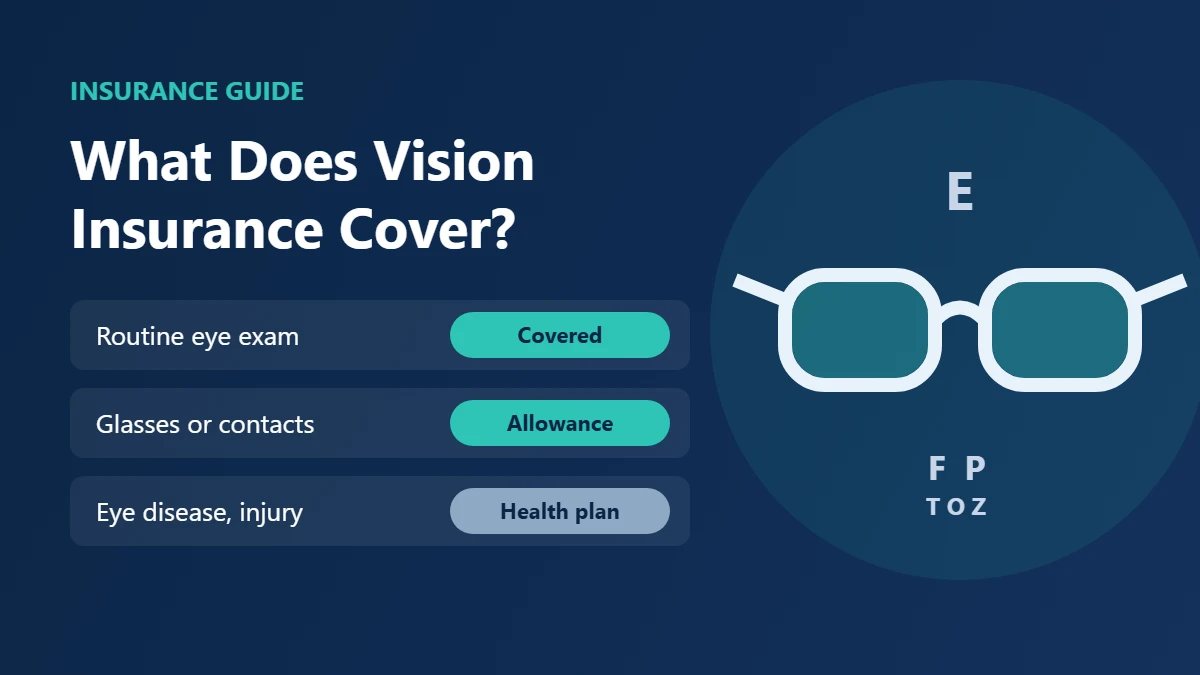
Vision care insurance primarily protects subscribers against the cost of routine eye care. It helps pay for regular eye exams and for corrective eyewear such as glasses and contact lenses, usually through set copays and spending allowances. It is not designed to cover eye diseases or injuries. Those are generally handled by your health insurance.
In other words, vision insurance makes predictable eye care costs more affordable rather than protecting you from large, unexpected medical bills. Here’s what that means in practice and how to tell whether a plan is worth it.
Vision Coverage at a Glance
| Type of eye care | Usually paid by |
|---|---|
| Routine eye exam and vision test | Vision insurance |
| Eyeglass frames and lenses | Vision insurance, up to an allowance |
| Contact lenses | Vision insurance, often instead of glasses |
| Glaucoma, cataracts, infections, or eye injuries | Health insurance |
| Laser vision correction | Usually you, sometimes with a plan discount |
What Vision Insurance Typically Includes
HealthCare.gov defines vision coverage as a health benefit that at least partially covers vision care, like eye exams and glasses. Most plans are built around a few core benefits:
- Routine eye exams. A comprehensive exam, often once every 12 months, for a fixed copay.
- Frames. An allowance toward frames. If you choose a pricier pair, you pay the difference.
- Lenses. Standard prescription lenses, sometimes with discounts on coatings or upgrades.
- Contact lenses. An allowance for contacts, usually offered in place of glasses for that benefit period.
- Discounts. Some plans offer discounts on extra pairs or on laser vision correction.
Benefits reset on a schedule, commonly every 12 or 24 months, so check how often you can use each one.
What “Protection” Really Means Here
Vision insurance works more like a prepaid benefit than traditional insurance. You pay a premium, and in return you get set prices and allowances for care most people need regularly. It protects you from paying full retail price for exams and eyewear.
What it doesn’t do is protect you from a costly medical eye problem. A plan won’t usually pay for treating glaucoma, a retinal problem, or an eye injury. That’s why vision insurance is best seen as a complement to health insurance, not a replacement.
Vision Insurance vs. Health Insurance
The dividing line is whether the visit is routine or medical. A yearly exam to update your glasses prescription goes through vision insurance. A visit for eye pain, sudden vision changes, an infection, or a chronic condition is usually billed to health insurance.
Medicare follows the same split. According to Medicare.gov, Medicare doesn’t cover routine eye exams for eyeglasses or contact lenses. But Part B does cover some medical eye care, such as glaucoma screenings and diabetic eye exams for people who qualify. Medicare also doesn’t usually cover eyeglasses, with one notable exception: Part B covers one pair of glasses with standard frames, or one set of contacts, after cataract surgery that implants an intraocular lens. Some Medicare Advantage plans add routine vision benefits.
Who Gets Vision Coverage?
Children have stronger protections than adults. Under the Affordable Care Act, pediatric vision care is an essential health benefit. HealthCare.gov’s list of covered benefits includes pediatric services, including vision care, but notes that adult vision coverage isn’t an essential health benefit.
That means adults usually get vision insurance in one of three ways: through an employer, through a health plan that includes it as an extra, or by buying a stand-alone vision plan. HealthCare.gov notes that the Marketplace doesn’t sell stand-alone vision plans, so adults who want one typically buy it directly from an insurer.
How Vision Insurance Works
- Choose an in-network eye doctor to get the full benefit. Out-of-network visits may be reimbursed at a lower amount, if at all.
- Pay your copay for the exam.
- Use your allowance toward frames, lenses, or contacts.
- Pay any difference if you choose eyewear that costs more than your allowance.
- Wait for your benefits to reset before using them again.
Your Rights When Buying Glasses
Your vision plan doesn’t lock you into buying from your eye doctor. The Federal Trade Commission says your prescriber must give you a copy of your prescription, whether you ask for it or not, at no extra charge. You don’t have to buy glasses or contacts from the prescriber who did your exam, so you can compare prices online or at other stores, though in-network retailers usually give you the most value from your plan.
Is Vision Insurance Worth It?
It depends on how much eye care you use. Add up what you’d pay without coverage for an exam and new glasses or contacts, then compare it with a year of premiums plus copays.
For example, suppose a plan costs $15 a month, or $180 a year. If you get an exam and new glasses every year, the plan’s exam benefit and frame allowance may easily outweigh that cost. If you have perfect vision and only need an exam every few years, paying out of pocket may be cheaper. Employer plans are often the best value, since employers frequently cover part of the premium.
When comparing plans, look beyond the monthly premium. Check the exam copay, the frame and contact lens allowances, how often benefits renew, whether your preferred eye doctor is in network, and whether any waiting period applies before you can use the benefits.
The Bottom Line
Vision care insurance primarily protects subscribers from the cost of routine eye exams and corrective eyewear, through copays and allowances for glasses and contacts. It doesn’t cover medical eye conditions or injuries, which belong to health insurance, and Original Medicare doesn’t cover routine vision care. If you or your family wear glasses or contacts, a vision plan, especially through an employer, can be well worth it. Just check the network, allowances, and how often benefits renew.