
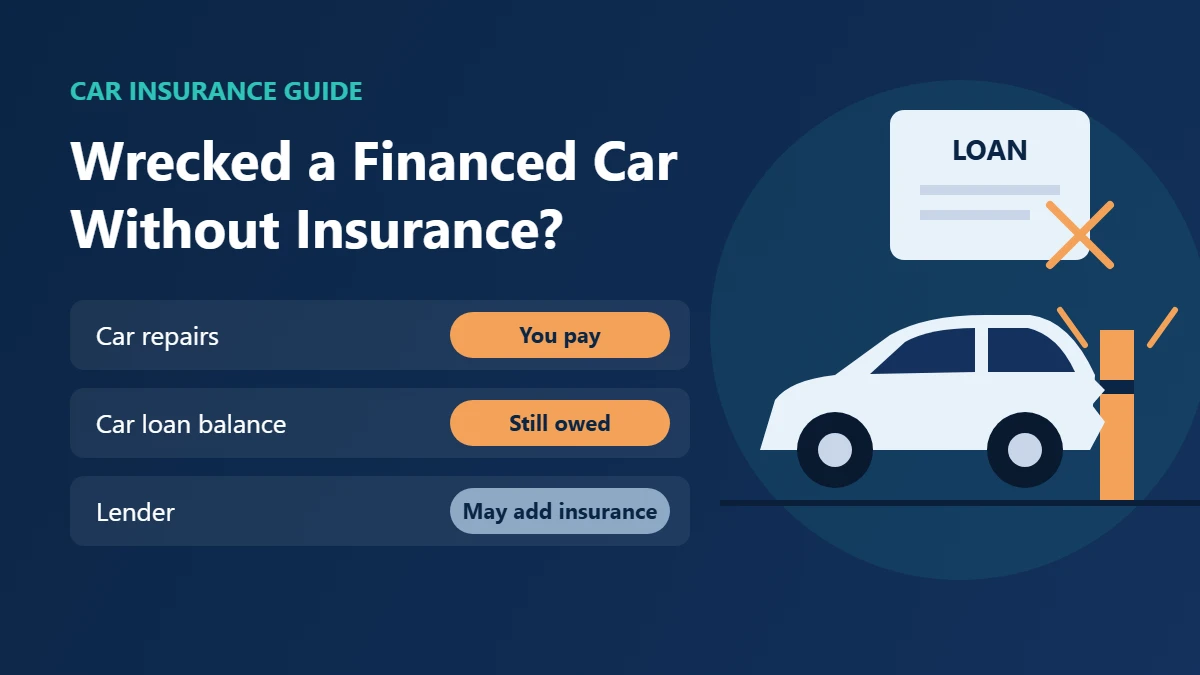
If you wreck a financed car without insurance, you still owe the entire loan, even if the car is destroyed. No insurer will pay to repair it or pay off the lender, you’re personally responsible for any damage or injuries you caused to others, and your state can penalize you for driving uninsured. Your lender may also add its own costly insurance to your loan, and if you fall behind on payments, the car can be repossessed and you can still owe money afterward.
Here’s how each of those consequences works and what to do next.
Who Pays for What Without Insurance
| Cost | Who pays if you had no insurance |
|---|---|
| Repairs to your financed car | You |
| Your car loan, even if the car is totaled | You, every remaining payment |
| The other driver’s car and injuries (you’re at fault) | You personally |
| Your own medical bills | You or your health insurance |
| State fines and reinstatement costs | You |
Your Loan Doesn’t Go Away
A car loan is a debt, not a rental. The lender doesn’t care whether the car runs. You still owe every payment on the schedule, even if the car is sitting in a salvage yard.
Normally, insurance protects both you and the lender. If a financed car is totaled, the insurer pays the car’s actual cash value, minus your deductible, and that money goes toward the loan. Without insurance, there’s no payout at all. For example, if you owe $18,000 and the car was worth $15,000 before the crash, insurance would typically cover most of that balance. Without it, you owe the full $18,000 on a car you can no longer drive.
Gap Insurance Won’t Fill the Hole
Gap insurance pays the difference between what your car is worth and what you still owe after a total loss. But it’s designed to work alongside your regular coverage, not instead of it. According to Insurance.com, you need to carry both comprehensive and collision coverage to add gap insurance, and gap doesn’t replace any of the underlying coverages. If you had no auto insurance, expect gap to provide little or no help.
What Your Lender Can Do
Almost every auto loan requires you to keep the car insured, usually with comprehensive and collision coverage. Letting coverage lapse breaks that agreement, and lenders have ways to respond.
Force-placed insurance. If you don’t carry the required coverage, your lender may buy insurance on the car and add the cost to your bill. The Consumer Financial Protection Bureau notes that this coverage protects the lender and the vehicle, but not you. It usually costs more than a policy you’d buy yourself, and it doesn’t include liability coverage for others. Once you buy your own qualifying policy, send proof to your lender right away and ask it to cancel the force-placed coverage and stop the charges.
Repossession and a deficiency balance. If the accident leaves you unable to keep up with payments, the lender can repossess the car. In many states, that can happen without a warning or court order once you miss payments. The car is then sold, and you can owe the rest. The CFPB explains that if you owe $10,000 and the lender sells the car for $7,500, you’d owe a deficiency balance of $2,500 plus repossession fees. A wrecked car sells for even less, which can leave a bigger balance.
Missed payments and a repossession can also damage your credit for years.
Legal Penalties for Driving Uninsured
Nearly every state requires liability insurance. According to the Insurance Information Institute, penalties range from fines, which can reach $5,000 for repeat offenses, to license or registration suspension. Some states can also impose jail time, confiscate license plates, or impound vehicles. Many states also require proof of future insurance, such as an SR-22, before restoring your driving privileges.
What If the Other Driver Caused the Crash?
If someone else was at fault, their liability insurance should pay to repair your car and cover your injuries, and the money can go toward fixing the lender’s collateral. That helps a lot. But you still drove without required insurance, so state penalties and your lender’s insurance requirements still apply.
What If You Only Had Liability Insurance?
Liability coverage pays for the other driver’s damage and injuries if you caused the crash, up to your limits. It doesn’t pay anything toward your own car. Since most lenders require collision and comprehensive, carrying only liability on a financed car usually still violates your loan agreement, and you’d owe the full balance on a damaged or totaled car.
What to Do If It Already Happened
- Handle the scene. Call police if anyone is hurt, exchange information, and take photos.
- Get insured immediately. A new policy won’t cover the past crash, but it stops further penalties and force-placed charges. See how to get car insurance after a lapse.
- Call your lender. Explain the situation and ask about hardship options before you miss a payment.
- File against the other driver if they were at fault.
- Get repair estimates and decide whether repairing the car makes financial sense.
- Talk to a lawyer if anyone was injured or you’re being sued.
Driving a leased car instead? The rules are similar but involve the leasing company. See what happens when you crash a leased car without insurance.
The Bottom Line
Wrecking a financed car without insurance leaves you owing the full loan, paying for repairs and any damage you caused, and facing state penalties. Gap insurance generally won’t help without regular coverage, your lender may add expensive force-placed insurance, and falling behind can lead to repossession and a deficiency balance. Get insured right away, talk to your lender early, and keep full coverage for as long as you owe money on the car.