
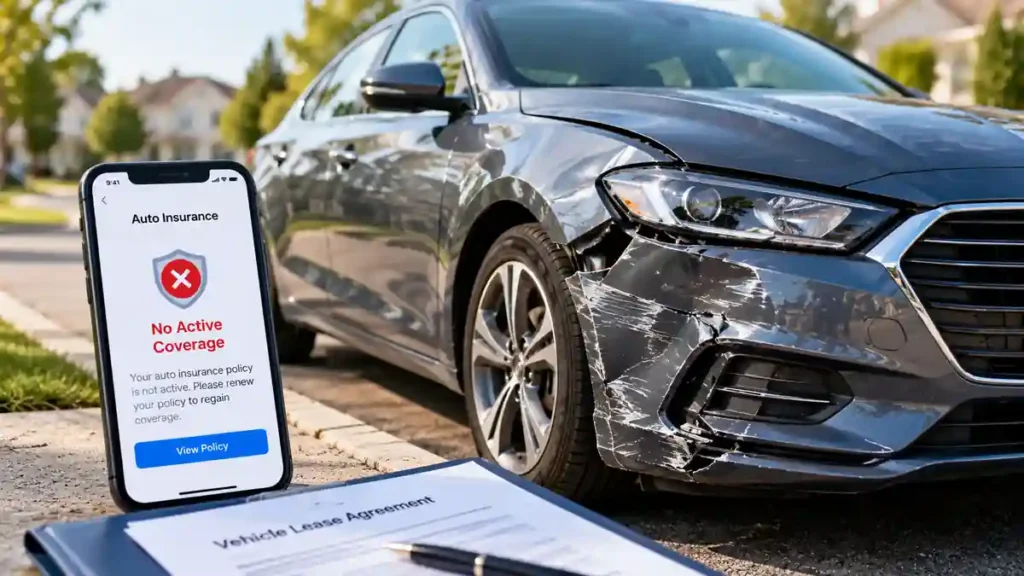
What happens when you crash a leased car without insurance? You could face significant financial and legal consequences because the leasing company owns the vehicle. Depending on the accident, you may have to pay for vehicle damage, property damage, or injuries you legally caused. You could also violate your lease agreement and face state penalties for driving without required insurance. However, the outcome depends on your state, fault, lease terms, vehicle damage, and any other available insurance or GAP coverage.
What Happens If You Crash a Leased Car Without Insurance?
If you crash a leased car without insurance, you may be personally responsible for costs that insurance would normally cover. These can include:
- Repairs or replacement of the leased vehicle
- Damage to another person’s vehicle or property
- Certain injury-related claims
- Lease-related charges or obligations
- State penalties for driving without required insurance
The exact consequences vary by state and lease agreement. Being uninsured and being at fault are also separate issues.
Why Is a Leased Car Different?
When you lease a vehicle, you are paying to use it while the leasing company generally remains the owner. Your lease can therefore require you to maintain specific insurance and follow certain rules after an accident.
Leases commonly require liability coverage and physical-damage coverage such as collision and comprehensive. The exact limits and requirements depend on the lessor, lease contract, policy, and state law.
This means an uninsured crash can create both an accident-related financial problem and a potential lease-contract problem.
Who Pays for the Leased Car Damage?
If You Caused the Accident
If you caused the crash and have no collision coverage, you may have to pay for damage to the leased vehicle yourself. You could also be personally exposed to covered property-damage or injury claims from others because there may be no liability insurer paying or defending covered claims on your behalf.
If Another Driver Caused the Accident
If another driver is legally responsible, their liability insurance may potentially cover covered damage to your leased vehicle, subject to policy limits and state law.
However, your lack of required insurance can still create a separate issue with your state or leasing company.
If Both Drivers Were at Fault
If both drivers share responsibility, state fault rules can affect how much you may recover. Comparative-fault and contributory-fault rules differ by state.
What If the Leased Car Can Be Repaired?
If the vehicle is repairable, get a repair estimate and check your lease before authorizing major work. The lessor may have requirements concerning accident reporting, repair facilities, parts, inspections, or repair quality.
If you caused the accident without collision coverage, you may have to pay some or all of the repair costs yourself.
Avoid assuming that repairing the vehicle yourself or hiding the accident solves the problem. Your lease may require you to report the accident and meet specific repair standards.
What If the Leased Car Is Totaled?
A total loss is more complicated because the vehicle’s value may differ from the amount required to settle the lease.
Important figures can include:
- Actual cash value (ACV): The vehicle’s value immediately before the loss.
- Lease payoff: The amount required to satisfy the lease under its total-loss provisions.
- Insurance payment: The applicable settlement from an insurer.
- Deductible: The amount you may have to pay under an applicable policy.
- GAP coverage: Protection that may cover a qualifying difference between an insurance settlement and the amount owed.
You do not automatically owe every remaining lease payment plus the residual value. The actual amount depends on your lease and applicable contracts.
Does GAP Insurance Cover a Leased Car With No Insurance?
GAP insurance is designed to help with a qualifying shortfall between an applicable insurance payout and the amount owed under a lease or financing agreement.
GAP does not replace car insurance.
If you had no primary insurance when the crash occurred, do not assume GAP will automatically pay for the loss. Check the specific GAP agreement or lease provisions to determine whether the loss qualifies.
What If You Only Had Liability Insurance?
Liability insurance generally helps cover covered damage or injuries you legally cause to others. It generally does not pay for damage to your own leased vehicle when you cause the accident.
| Coverage | Your Leased Car | Damage You Cause to Others |
|---|---|---|
| No insurance | Generally not covered | You may be personally exposed |
| Liability only | Generally not covered | Potentially covered |
| Liability + collision | Potentially covered | Potentially covered |
| Liability + collision + GAP | Potentially covered + qualifying GAP protection | Potentially covered |
Actual coverage depends on your policy, limits, exclusions, lease, and state law.
Can the Leasing Company Take Back the Car?
Failing to maintain insurance required by your lease can potentially violate the agreement. The lessor may have contractual remedies, but repossession is not an automatic result of every uninsured accident.
The lease and applicable state law determine what the leasing company can do.
What Penalties Can You Face?
Penalties for driving without required insurance vary by state. Depending on the circumstances, they can include fines, license or registration consequences, reinstatement fees, proof-of-insurance requirements, or other penalties.
There is no single nationwide penalty.
What Should You Do After the Crash?
If this has actually happened:
- Check for injuries and get emergency help if needed.
- Report the accident when required.
- Photograph the scene and collect relevant information.
- Confirm whether any insurance was actually active.
- Determine who was at fault.
- Review your lease and notify the leasing company as required.
- Get a repair estimate or determine whether the car is totaled.
- Check for GAP coverage.
- Get the lease payoff and other amounts in writing.
- Consider local legal advice if the potential financial exposure is significant.
Frequently Asked Questions
Do I have to pay the remaining lease payments?
Not necessarily. The amount owed after a total loss depends on the lease’s total-loss provisions and applicable insurance or GAP protection.
What if another driver caused the crash?
Their liability insurance may potentially cover covered damage to your leased vehicle, but your uninsured status can still create separate state or lease consequences.
Can I repair the leased car myself?
Do not assume you can. Check the lease for accident-reporting, repair, parts, and inspection requirements first.
Can I be sued?
Potentially. The leasing company, another driver, or an injured person may have legal claims depending on the circumstances. A lawsuit is not automatic.
Bottom Line
Crashing a leased car without insurance can leave you responsible for vehicle damage, third-party claims, lease obligations, and state penalties. If the car is totaled, do not assume you automatically owe the entire remaining lease balance or that GAP will cover an uninsured loss. The final outcome depends on your state, fault, lease terms, vehicle damage, available insurance, and applicable GAP protection.
Read Also:-What Protection Does Vision Care Insurance Primarily Offer to Subscribers