
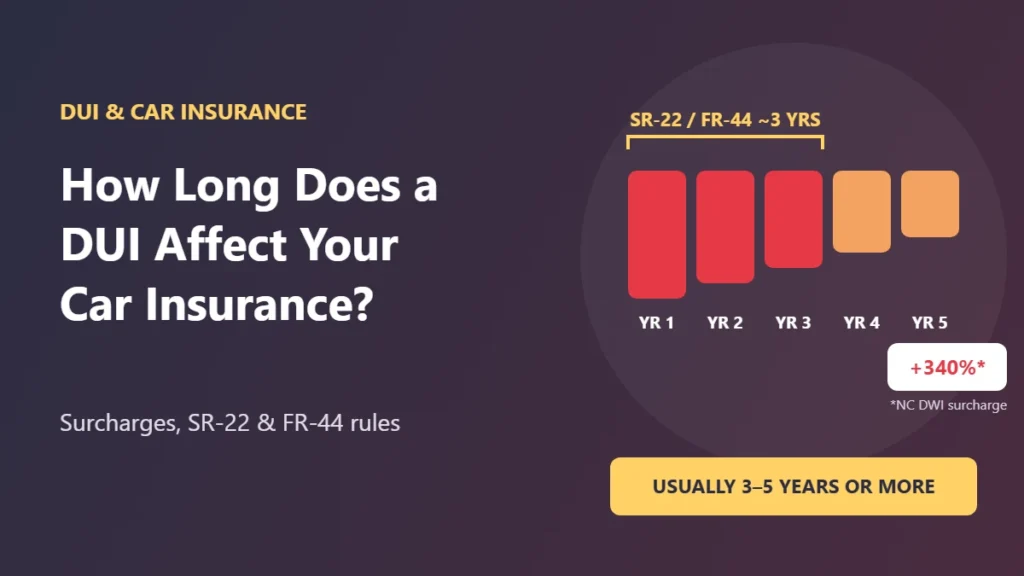
A DUI usually affects your car insurance for at least three to five years, and sometimes longer. How long depends on your state’s rules, how long the conviction stays on your driving record, and how long your insurer looks back when setting rates. Most drivers also have to carry proof of insurance, such as an SR-22, for about three years after a DUI, and Florida and Virginia require an FR-44 with higher limits. Some states set the timeline by law. North Carolina, for example, now surcharges a DWI for five policy years.
Here’s how the different clocks work, what a DUI can do to your premium, and how to get your rates back down.
Three Timelines After a DUI
| Timeline | What controls it | Typical length |
|---|---|---|
| Insurance surcharge | Your insurer and your state’s rating rules | Often 3 to 5 years, sometimes longer |
| SR-22 or FR-44 filing | Your state DMV or court | Often 3 years |
| Driving record | State law | Varies widely, often longer than the surcharge |
These clocks don’t end at the same time. Your SR-22 requirement might end after three years while the DUI still shows on your record and still affects quotes from some insurers.
How Much a DUI Can Raise Your Insurance
A DUI is one of the most expensive violations for car insurance. North Carolina’s rules show how steep it can be. Under the state’s Safe Driver Incentive Plan, a conviction for driving while impaired, or driving with a blood alcohol level of .08 or more, adds 12 points and a 340% surcharge. Even a driver under 21 convicted of driving after consuming alcohol or drugs gets 4 points and a 90% surcharge. On a policy that normally costs $1,500 a year, a 340% surcharge would add about $5,100.
The timeline also got longer there. For convictions worth four or more points that occur on or after July 1, 2025, North Carolina uses a five-year experience period, and the surcharge lasts five policy years. Before that date, the period was three years.
In most other states, each insurer sets its own surcharge. Expect a large increase, possible loss of good-driver discounts, and in some cases a nonrenewal notice.
SR-22 and FR-44 Requirements
SR-22
An SR-22 isn’t a type of insurance. It’s a form your insurer files with the state to prove you carry at least the required coverage. According to Progressive, most states require you to carry an SR-22 for about three years, though some require longer. If your policy lapses during that time, your insurer may notify the state, which can suspend your license again.
FR-44 in Florida and Virginia
Florida and Virginia use an FR-44 for DUI convictions, which requires higher liability limits than an SR-22. Under Florida Statute § 324.023, drivers convicted of DUI must carry at least:
- $100,000 for bodily injury to one person
- $300,000 for bodily injury to two or more people
- $50,000 for property damage
Those higher limits must be kept for at least three years. In Virginia, FR-44 limits are typically double the state’s minimums, which rose to 50/100/25 for policies effective on or after January 1, 2025.
How Long a DUI Stays on Your Driving Record
Driving record rules vary by state, and they’re often longer than insurance surcharge periods. Courts and DMVs also use lookback periods for repeat offenses. In California, for example, the California DMV says a second or subsequent DUI within 10 years results in a one-year license suspension. Check your state DMV for your exact record period.
Insurers usually see violations through your motor vehicle record when you apply or renew. A DUI that’s still on your record can affect new quotes, even after your current insurer’s surcharge ends.
When Will Your Rates Go Down?
Rates usually start to improve as the DUI ages, assuming you avoid new tickets and accidents:
- Years 1 to 3: Highest rates. You’ll likely need an SR-22 or FR-44, and fewer insurers may offer coverage.
- Years 3 to 5: Filing requirements often end, and many insurers reduce or remove the surcharge.
- After 5 years: Many insurers no longer surcharge the DUI, though some still consider it while it’s on your record.
Rates don’t drop automatically on an anniversary date. The change usually shows up at your next renewal, so compare quotes around that time.
How to Lower Your Insurance After a DUI
- Keep your SR-22 or FR-44 active without a single lapse. A lapse can restart problems and trigger a suspension.
- Shop around every year. Insurers weigh DUIs very differently.
- Keep a clean record from here on. New violations stack on top of the DUI.
- Raise your deductible or drop collision on an older car to offset the surcharge.
- Complete any required programs on time, such as DUI education or an ignition interlock.
- Ask about discounts you still qualify for, like bundling or paying in full.
If your insurer drops you, see how to get car insurance after non-renewal.
Frequently Asked Questions
Does switching insurers remove a DUI?
No. New insurers check your driving record. Switching can still save money, since some companies surcharge DUIs less than others.
Does a DUI affect insurance as long as an accident does?
Usually longer, and with a much bigger surcharge. For comparison, see how long an accident stays on your car insurance.
What if I don’t own a car but need an SR-22?
You can usually buy a non-owner policy with an SR-22 filing to meet the requirement and keep your coverage history continuous.
The Bottom Line
A DUI typically affects your car insurance for three to five years, and longer in some states and with some insurers. Expect a big surcharge and an SR-22 or FR-44 for about three years. Keep your filing active, avoid new violations, and compare quotes at each renewal as the DUI ages.