
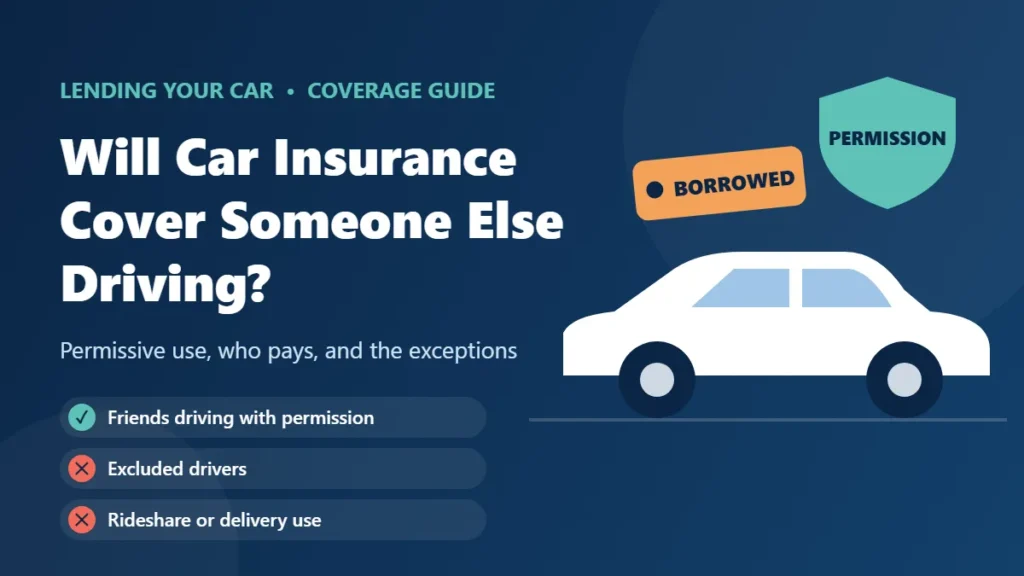
Usually, yes. In the U.S., most auto policies cover someone else driving your car as long as you gave them permission and they aren’t excluded from your policy. Your insurance pays first, the driver’s own insurance may pay after yours runs out, and any claim goes on your record, not theirs.
There are important exceptions. Here’s how coverage works, who pays after a crash, and when your policy may not protect you.
How Permissive Use Works
When you let a friend, relative, or neighbor borrow your car, insurers call that “permissive use.” Most standard policies cover you, your family members, and people driving your car with your permission. The Texas Department of Insurance’s auto insurance guide lists permitted drivers among the people most policies cover, and notes that when you borrow a car, the car owner’s insurance pays the claim.
In practical terms, your coverages follow your car:
- Liability pays for injuries and property damage the borrower causes to others, up to your limits.
- Collision pays to repair your car after a crash, minus your deductible.
- Comprehensive covers theft, hail, vandalism, and similar damage while they have the car.
- Medical payments or PIP, if you carry them, can help with injuries to people in your car.
If you only carry liability, nothing pays to fix your own car when a borrower crashes it. For more on why coverage generally attaches to the vehicle, see our guide on whether car insurance is on the car or the driver.
Whose Insurance Pays After a Crash?
Your policy is primary, meaning it pays first. If the borrower has their own auto policy, it may act as secondary, or excess, coverage once your limits are used up, as Plymouth Rock explains.
Here’s an example. Your friend borrows your car and causes a crash that leaves the other driver with $70,000 in medical bills. If your bodily injury limit is $50,000 per person, your insurer pays $50,000. Your friend’s own policy may cover the remaining $20,000. If your friend has no insurance, the injured driver could pursue your friend, and possibly you, for the difference.
Two more points catch owners by surprise:
- You pay the deductible. If your collision deductible is $1,000, that comes out of your pocket unless the borrower agrees to repay you.
- The claim lands on your policy. An at-fault accident by a borrower can raise your premium at renewal, even though you weren’t driving.
When Your Insurance May Not Cover Someone Else
Excluded drivers
If you’ve formally excluded someone from your policy, often a household member with a poor driving record, your insurer won’t pay if they drive your car. As Experian notes, an excluded person can’t be treated as a permissive driver. You and the driver could be personally responsible for every dollar of damage.
Regular drivers who aren’t listed
Permissive use is meant for occasional borrowing. Anyone who lives with you or drives your car regularly, like a roommate, a partner, or a teen with a new license, usually needs to be listed on your policy. Leaving them off can lead to a denied claim or a canceled policy.
Lower limits for permissive drivers
Some policies contain a “step-down” clause that reduces coverage for borrowers to your state’s minimum liability limits, which are far lower than many owners carry. Experian also notes that limits for a permissive driver may be lower than when you drive. Read your policy or ask your agent directly whether this applies.
Business, rideshare, and delivery use
Personal auto policies generally exclude driving for a ride-hailing app or delivering food or packages for pay. If your friend borrows your car to drive for Uber or DoorDash, your policy likely won’t cover a crash during that work.
No permission
If someone takes your car without your consent, permissive use doesn’t apply. Report a stolen car to the police and your insurer right away. Comprehensive coverage may pay for damage from a theft.
Can You Be Sued If Someone Crashes Your Car?
Possibly. Beyond insurance, many states let injured people sue an owner for “negligent entrustment,” which means knowingly lending a car to someone who is unlicensed, impaired, or known to drive recklessly.
Before You Lend Your Car: A Quick Checklist
- Confirm the driver has a valid license and isn’t excluded on your policy.
- Ask your insurer whether your policy has a step-down clause for permissive users.
- Check that your liability limits are high enough to protect your savings.
- Ask whether the borrower has their own auto insurance that could act as backup.
- Agree in advance who pays the deductible if they damage your car.
- Make clear the car can’t be used for rideshare or delivery work.
If Someone Crashes Your Car
Make sure everyone is safe and call 911 if anyone is hurt. Have the driver exchange information with the other party and take photos. Then call your insurer, since you’re the policyholder, and give them the driver’s name and license details. Rules for who pays first can vary by state; our article on whether insurance follows the car or driver in Texas shows how one state handles it.
Frequently Asked Questions
Does the person borrowing my car need their own insurance?
Not to be covered under your policy as a permissive driver. But their own coverage can help if damages exceed your limits. People who often borrow cars but don’t own one can buy a non-owner policy; see our guide on insuring a car you don’t own.
Will my rates go up if a friend crashes my car?
They can. The claim is filed on your policy, so an at-fault accident may affect your premium at renewal.
Does my insurance cover me when I drive someone else’s car?
Generally, their insurance pays first, and your own liability coverage may act as backup.
The Bottom Line
Car insurance will usually cover someone else driving your car with your permission, because coverage follows the vehicle. Before you hand over the keys, make sure the driver isn’t excluded, isn’t a regular driver who should be listed, and won’t use your car for work, and confirm your limits apply in full to borrowers.