
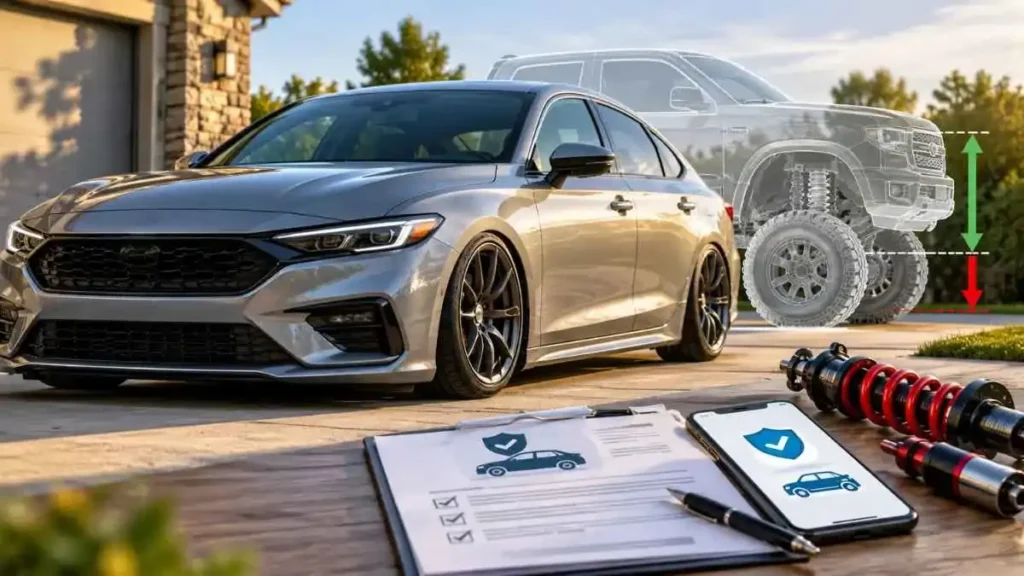
Does adjusting your car height void insurance? No, raising or lowering your car does not automatically void your insurance. However, changing the ride height is generally considered a vehicle modification and may affect your premium, coverage, eligibility, or how aftermarket parts are handled after a claim.
If you install a lift kit, lowering springs, coilovers, or air suspension, your insurer may need to know. Your policy terms, state laws, disclosure requirements, and aftermarket coverage all matter.
Does Adjusting Your Car Height Void Insurance?
Adjusting your car’s height does not automatically cancel your insurance policy. The important issue is how the modification fits within your insurer’s rules and your policy.
A height modification can change the vehicle’s original configuration, handling characteristics, value, and potential repair costs. Because of this, an insurance company may review the modification when determining coverage or underwriting risk.
It is also important to separate three different issues:
- Vehicle modification: Changing the car from its factory setup.
- Policy cancellation or voiding: Ending or invalidating insurance under applicable policy and legal rules.
- Modified-parts coverage: Whether aftermarket equipment is covered and for how much.
These are not the same thing. A modified car can still be insured, while specific aftermarket parts may have limited coverage.
What Counts as a Car Height Modification?
Common height modifications include:
Lowering a Car
Examples include:
- Lowering springs
- Coilovers
- Air suspension
- Adjustable suspension systems
These changes can affect ground clearance, suspension geometry, tires, and handling.
Raising a Car
Examples include:
- Suspension lift kits
- Leveling kits
- Suspension spacers
- Larger wheels and tires
A lift can increase ground clearance and may also change the vehicle’s suspension setup and repair requirements.
Can Lowering Your Car Affect Insurance?
Yes, lowering your car can affect insurance, but it does not automatically mean your premium will increase.
An insurer may consider factors such as the vehicle’s value, aftermarket equipment, potential repair costs, suspension components, wheels and tires, and changes to the vehicle’s characteristics.
Different insurers can treat the same modification differently. Some may accept a lowered vehicle under their normal rules, while others may have restrictions or require additional coverage.
There is no universal U.S. insurance surcharge simply because a vehicle has been lowered.
Can a Lift Kit Affect Car Insurance?
Yes. A lift kit is an aftermarket modification that can affect how an insurer evaluates a vehicle.
A lifted vehicle may also have larger wheels, tires, suspension components, or other equipment that increases repair or replacement costs.
If you install a lift kit, tell your insurer what was changed and ask whether the modification and aftermarket equipment are covered.
However, a lift kit does not automatically make a vehicle uninsurable.
Do You Have to Tell Your Insurance Company?
You should check with your insurer about significant modifications and confirm how they affect your policy.
When discussing a modification, provide:
- Type of modification
- Amount of lift or drop
- Parts installed
- Cost of the parts
- Installation cost
- Whether the work was professional or DIY
- Other related modifications
Also ask:
- Is the modification allowed under my policy?
- Will my premium change?
- Are the aftermarket parts covered?
- Do I need an endorsement?
- Is Custom Parts and Equipment coverage available?
- Are there limits on vehicle modifications?
Keeping the insurer’s response and your receipts can be helpful later.
Can an Undisclosed Modification Cause a Claim Problem?
It can create complications, but an undisclosed modification does not automatically mean a claim will be denied.
If you file a claim, the insurer may review your policy, the vehicle, the modification, and the circumstances of the loss.
The outcome can depend on:
- State law
- Policy wording
- Type of modification
- Whether the modification was material to the insurer
- Whether it contributed to the accident
- Type of coverage involved
This is why disclosing significant modifications is safer than assuming they do not matter.
Does Insurance Cover Lift Kits and Aftermarket Parts?
Not necessarily.
A standard auto policy does not always provide the level of protection an owner expects for expensive aftermarket equipment. Some insurers offer Custom Parts and Equipment (CPE) coverage or similar endorsements.
Coverage can apply differently to:
- Lift and lowering equipment
- Wheels and tires
- Suspension components
- Custom accessories
- Other aftermarket parts
Check your coverage limits, deductible, and exclusions. Keep receipts and installation records showing what you purchased and paid.
What Happens if a Modified Car Is Totaled?
A modification’s purchase price is not automatically added to your vehicle’s value.
For example, suppose your car is worth $20,000 and you spent $5,000 on aftermarket suspension, wheels, and other modifications.
You should not automatically assume the insurer will pay $25,000.
The actual payment depends on the applicable policy, vehicle valuation, coverage limits, deductible, and whether the aftermarket equipment is covered.
Is There a Universal 2-Inch or 4-Inch Insurance Rule?
No. There is no universal U.S. insurance rule saying that a 2-inch lift, 4-inch lift, or specific amount of lowering automatically increases your premium or voids your insurance.
Online claims about specific insurance height thresholds should be treated carefully. Insurance underwriting rules and vehicle-modification laws can vary by insurer and state.
Are Lifted and Lowered Cars Legal?
Not necessarily in every state.
States can have different requirements involving vehicle height, bumper height, ground clearance, suspension, wheels, tires, lighting, and inspections.
Remember that vehicle legality and insurance coverage are separate issues. A modification must comply with applicable state requirements, and you should also confirm that your insurer accepts it.
An illegal modification does not automatically mean your entire insurance policy is void, but it can create legal or insurance complications.
What Should You Do Before Modifying Your Car?
Before raising or lowering your vehicle:
- Check your state’s vehicle requirements.
- Contact your insurance company.
- Explain the exact modification.
- Ask whether it is allowed under your policy.
- Ask whether your premium will change.
- Confirm aftermarket-parts coverage.
- Ask about CPE coverage.
- Keep receipts and installation records.
- Take photos of the modifications.
- Keep important insurance information in writing.
What If You Already Modified Your Car?
Don’t automatically assume your insurance is void.
Contact your insurer and explain what you changed, including the parts, amount of lift or drop, installation, and cost.
Ask whether your policy needs to be updated and whether additional coverage is available.
Addressing the modification before an accident can help you understand your coverage and reduce the risk of an unexpected dispute later.
Frequently Asked Questions
Does lowering a car void insurance?
No. Lowering a car does not automatically void insurance, although it can affect premiums, eligibility, or aftermarket-parts coverage.
Does a lift kit affect insurance?
It can. A lift kit may affect underwriting, premiums, and coverage for aftermarket equipment.
Will lowering my car increase my insurance?
Not necessarily. There is no universal premium increase for lowered vehicles.
Does a 2-inch lift affect insurance?
It can, but there is no universal U.S. insurance rule that automatically changes coverage or premiums for a 2-inch lift.
Will insurance cover aftermarket suspension?
It depends on your policy. Ask your insurer whether additional Custom Parts and Equipment coverage is available.
Can insurance deny a claim because my car was modified?
A modification alone does not automatically mean a claim will be denied. Policy terms, disclosure, state law, and the circumstances of the claim can all matter.
Bottom Line
Does adjusting your car height void insurance? No, not automatically.
Raising or lowering your vehicle is generally a modification that can affect insurance, but the actual impact depends on your insurer, policy, state, and specific modification.
Before making a change, check your state’s requirements, tell your insurer, confirm aftermarket-parts coverage, and keep your receipts and installation records. Most importantly, don’t assume that a particular lift or drop measurement has the same insurance effect everywhere in the United States.
Read Also:-Why Do Car Insurance Companies Ask for Social Security Numbers