
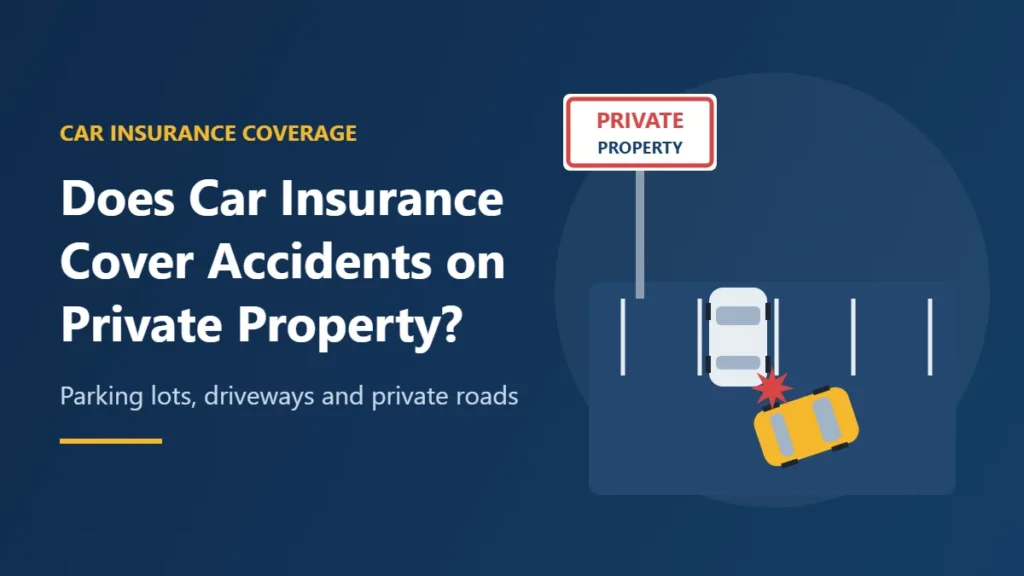
A fender-bender in a grocery store lot, backing into a gate at a friend’s house, a scrape on a private road in a gated community. None of these happened on a public street, so does your car insurance still apply?
Short answer: usually, yes. A personal auto policy follows your car, not the road it’s on, so liability, collision and comprehensive coverage generally apply in parking lots, driveways and private roads. What changes on private property is how fault gets proved, whether police will write a report, and a few exclusions that matter more off public roads.
Which Coverage Pays for What
- Liability: Pays for damage and injuries you cause to other people, such as denting another car in a parking lot or hitting someone’s mailbox.
- Collision: Pays to repair your own car after hitting another vehicle or object, whoever is at fault, minus your deductible.
- Comprehensive: Covers non-crash damage such as theft, vandalism, hail or a falling tree, wherever the car is parked.
- Uninsured motorist: Can help when the other driver has no insurance. Triple-I notes it can also apply in the case of a hit-and-run, which is common in parking lots. Policies and state rules vary, and collision is the backup if UM doesn’t apply.
The Exclusions That Matter Most on Private Property
A typical personal auto policy, such as this Texas personal auto policy form, excludes liability coverage for:
- Your own property: Damage to property “owned or being transported by an insured.” If you back into your own garage door, fence or second car, your liability coverage won’t pay. Collision can still fix the car you were driving.
- Intentional damage: Damage caused on purpose, such as ramming another car in a dispute.
- Racing and track events: Damage while taking part in, practicing for, or preparing for a “prearranged or organized” race, speed contest, stunting or performance event. Track days at a private raceway usually fall here, even though the track is private property.
Policies also commonly exclude business uses, such as paid deliveries without the right endorsement. Off-road use on private land can raise its own questions, covered in does car insurance cover off-road driving.
Common Private Property Scenarios
Parking lot collisions
These are covered like road crashes: liability for the other car, and collision for yours. Fault often turns on who had the right of way. A car in a main through lane typically has priority over one pulling out of a parking space, and a driver hitting a legally parked car is usually at fault. When two cars back into each other, insurers often split fault.
Your own driveway
If a guest backs into your parked car, their liability coverage should pay. If you hit your own second car or your house, see the own-property exclusion above. Your homeowners policy may cover the structure. See does homeowners insurance cover garage door damage. Weather or a falling tree damaging the car itself is a comprehensive claim. More in does homeowners insurance cover car damage in a driveway.
Hit-and-run while you’re parked
You come back to a dented door and no note. Check for witnesses and ask the store whether its cameras caught a plate. File a police report if you can, since many insurers require one for an uninsured motorist claim. Without the other driver, collision or UMPD, where your state and policy allow it, is usually how you’ll get paid.
Private roads and gated communities
Your coverage works the same way. Community rules such as speed limits and stop signs can be used as evidence of who drove carelessly.
When the property owner may share blame
A deep pothole, broken lighting or a missing stop sign can make the lot’s owner partly responsible. That may mean a premises liability claim against the owner’s insurance, especially for injuries.
Police Reports on Private Property
Expect less help from police. Many departments won’t write a full crash report for minor parking lot accidents with no injuries, and traffic tickets may not apply on private lots in some states. Texas, for example, says TxDOT collects crash reports from law enforcement for crashes on public roadways and the state highway system.
Still call police if anyone is hurt, a driver seems impaired, or the other driver leaves. Some states also require you to file your own accident report with the DMV when damage or injuries cross a set threshold, so check your state’s rules.
What to Do After an Accident on Private Property
- Check for injuries and call 911 if anyone is hurt.
- Photograph everything: both cars, where they ended up, lane arrows, stop signs and any lot hazards.
- Exchange information: name, license, plate, insurer and policy number.
- Find witnesses and ask whether the business has security cameras. Footage is often overwritten quickly.
- Ask security for an incident report if the lot has staff. It won’t assign fault, but it’s a record.
- Report to your insurer promptly. See how long you have to report a car accident to insurance.
Will a Private Property Claim Raise My Rates?
Location doesn’t change how insurers rate a claim. An at-fault parking lot crash generally counts the same as an at-fault crash on the street, and a not-at-fault or comprehensive claim is treated differently from one where you caused the damage. For a small scrape near your deductible, compare the repair cost with your deductible before filing.
The Bottom Line
Car insurance generally covers accidents on private property just as it does on public roads. The main differences: liability won’t pay for your own property, organized racing and intentional damage are excluded, and you’ll often have to gather the evidence yourself because police may not file a report.
This article is general information, not legal or insurance advice. Policy wording, exclusions and reporting rules vary by insurer and state. Check your own policy or ask your agent.